
Views: 0 Author: Site Editor Publish Time: 2026-10-22 Origin: Site


Electrical termination points remain the most vulnerable segments in any power distribution system. System downtime, thermal runaway, and equipment damage rarely stem from the cable itself. They almost exclusively originate from poorly specified or improperly installed terminations. Engineers and installers face a harsh business reality every day. You cannot compromise on your connection points without risking catastrophic failure.
A high-quality Cable Lug serves as an engineered solution to these exact problems. It actively eliminates micro-arcing. It manages extreme thermal expansion during peak load cycles. Most importantly, it ensures a permanent, low-resistance mechanical bond between the conductor and the equipment. Understanding how these critical components function will transform your approach to electrical safety and system longevity. You will learn the physics behind connection failures, how to evaluate different lug types, and the best practices for installation.
Material Purity is Non-Negotiable: Reliable lugs begin with high-grade, seamless copper tubing to ensure maximum conductivity and structural integrity during compression.
Proper Crimp Mechanics Prevent Failure: A high-quality cable lug relies on cold-welding principles; matching the lug, the die, and the wire gauge strictly dictates performance.
Application Dictates Type: Choosing between standard, heavy-duty, or bi-metallic lugs depends directly on environmental exposure, vibration levels, and conductor material.
Compliance Mitigates Risk: Procurement should require verified UL listings and strict adherence to dimensional standards to prevent thermal events in high-stakes environments like battery banks.
Terminations often fail silently before causing catastrophic damage. We must understand the underlying physics to prevent these events. Loose or mismatched connections inevitably increase electrical resistance. High resistance generates localized heating at the joint. This excess heat accelerates the oxidation of the surrounding metals. Oxidation further increases resistance. This dangerous loop creates a thermal runaway cycle. Eventually, the connection melts, sparks, or catches fire.
Industrial environments and mobile applications introduce another major threat. Continuous vibration and mechanical stress constantly test termination points. If a Cable Lug lacks adequate structural rigidity, wire strands will fatigue and break. Mechanical strain also pulls the conductor out of the barrel. Engineers must account for these movement forces during the design phase.
Underspecified components carry massive risks. Ignoring environmental demands leads directly to NEC and OSHA compliance violations. Facilities face severe penalties for these infractions. Beyond fines, poor terminations force premature equipment replacement. Burnt contactors and melted busbars halt production lines completely. More alarmingly, these failures represent significant fire hazards. Investing in the correct termination hardware prevents these dangerous and costly outcomes.
Common Mistake: Installers often reuse old hardware to save time. Reusing a stretched or previously torqued bolt compromises the clamping force. Always use new, properly graded hardware when securing a lug to a busbar.
You cannot use a universal approach when selecting termination hardware. Application environments dictate specific design requirements. We must match the component to the exact operating conditions.
Standard lugs work perfectly for rigid, indoor panel building. They handle standard commercial voltages in climate-controlled spaces. They feature standard wall thicknesses suitable for most stationary applications.
Heavy-duty alternatives feature significantly thicker wall construction. You need these for high-vibration applications. Heavy industrial machinery, mining equipment, and deep-cycle battery banks demand this extra material. The thicker copper resists mechanical deformation under constant stress.
Manufacturers use different materials to solve specific electrical challenges.
Tinned Copper Lugs: These represent the industry standard. The tin plating prevents corrosion while the copper maintains exceptional conductivity.
Aluminum Lugs: Manufacturers design these specifically for aluminum conductors. Cross-material contamination remains a serious danger. You must use proper anti-oxidant compounds to prevent galvanic corrosion.
Bi-Metallic Lugs: These offer the necessary solution for safely transitioning between aluminum cables and copper busbars. They prevent the two dissimilar metals from reacting unfavorably.
Standard barrels work well for rigid, coarse-stranded wire. However, highly flexible cables require a different approach. You should specify flared barrels for fine-stranded or welding cables. The flared entry prevents fine strands from folding back during insertion. This guarantees all strands enter the compression zone.
Table 1: Cable Lug Selection Matrix
Application Environment | Recommended Lug Type | Key Characteristic |
|---|---|---|
Indoor Control Panels | Standard Tinned Copper | Standard wall, high conductivity |
Industrial Machinery | Heavy-Duty Copper | Thick wall, vibration resistant |
Aluminum Feeders | Aluminum / Bi-Metallic | Galvanic corrosion prevention |
Welding / Battery Cables | Flared Barrel | Prevents fine-strand fold-back |
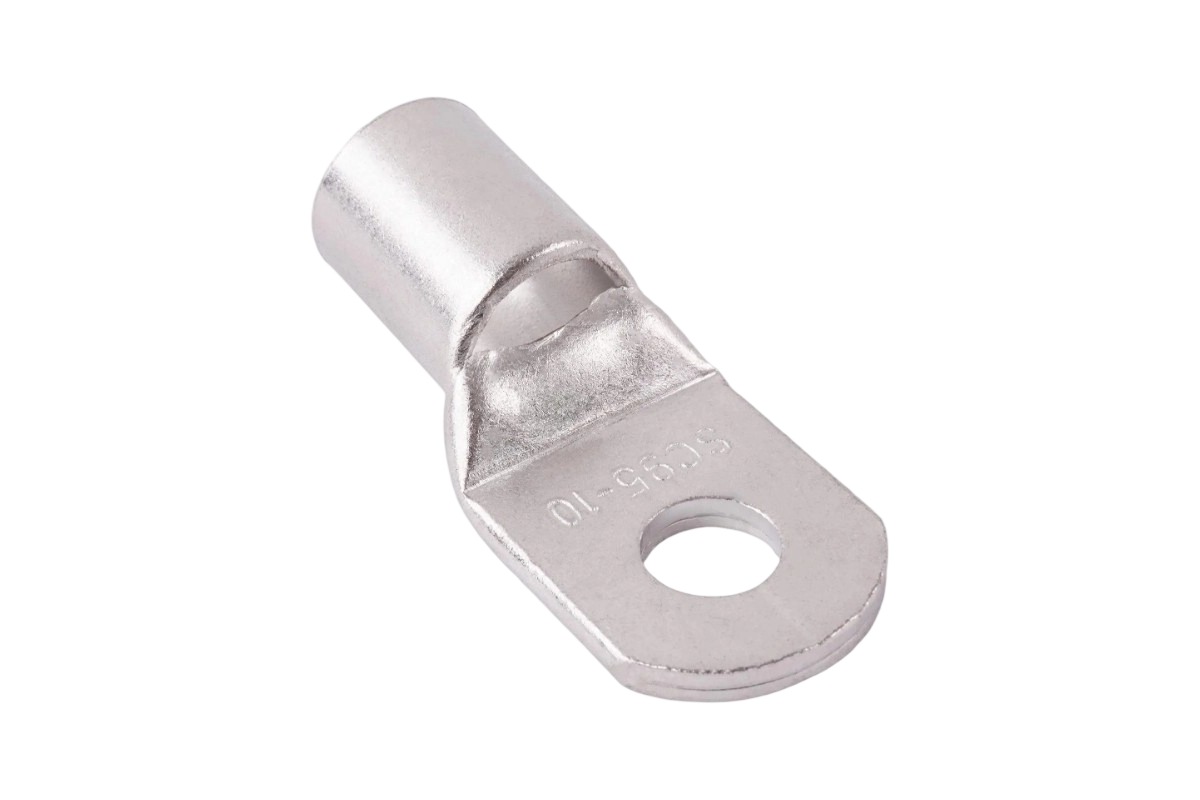
High-quality manufacturing separates reliable components from dangerous ones. You must know what physical marks indicate a well-made product. The manufacturing process directly impacts field performance.
Premium manufacturers use continuous copper tube extrusion. This seamless construction creates a uniform wall thickness. Cheap, stamped-and-folded alternatives often hide a seam down the barrel. These seams frequently split open under high crimp pressure. A split barrel loses all mechanical holding power and ruins the electrical connection.
Quality components always undergo an annealing process. This specialized heat treatment softens the metal at a molecular level. Annealing allows the copper to compress fluidly around the wire strands. It forms a solid mass without cracking or fatiguing. Un-annealed copper remains brittle and frequently fractures during installation.
Bare copper oxidizes rapidly when exposed to the atmosphere. Electro-tin plating provides a necessary barrier. You need uniform tin plating to prevent oxidation. This becomes especially critical in harsh, damp, or corrosive environments. The tin layer ensures long-term conductivity.
A simple design feature provides massive quality assurance. The inspection hole allows installers to verify full cable insertion. You must check this window prior to crimping. If you cannot see the copper strands through the hole, the cable is not seated deeply enough. This prevents shallow crimps which eventually pull out under tension.
Best Practice: Always position the inspection window so it remains visible after you mount the cable. This allows future inspectors to verify the installation quality.
Even the best hardware fails if installed incorrectly. Proper installation requires specific techniques, especially in demanding environments. We must rely on engineered mechanical processes rather than outdated methods.
Many older technicians still advocate for soldering heavy gauge connections. However, mechanical crimping is structurally superior. A proper crimp creates a cold weld between the strands and the barrel. Industry standards mandate crimping for heavy gauge wires. Solder can easily melt under high fault-current temperatures. When solder melts, the connection separates, causing immediate system failure.
A Cable Lug is only as reliable as the tool used to compress it. You must use the correct hydraulic or ratcheting crimp tool. Tool and die synchronization dictates success. Under-crimping leaves dangerous microscopic voids inside the barrel. These voids trap oxygen and cause resistance. Conversely, over-crimping crushes the copper and damages its structural integrity. Always match the die index exactly to the manufacturer specifications.
Battery bank connections present unique demands. Solar arrays and UPS systems experience frequent thermal cycling. Batteries also outgas corrosive acids. You must manage acid exposure carefully. Installers must apply dielectric or anti-oxidant grease correctly to seal the joint. Furthermore, you should use adhesive-lined heat shrink over the barrel. This seals the inspection window and prevents acid ingress.
Procurement teams hold the first line of defense against electrical failures. You cannot simply order based on price. A rigorous auditing process ensures only safe components enter your facility.
You must warn your teams against generic sizing. A reliable component maps precisely to the specific American Wire Gauge (AWG). It must also match the exact stranding class. A Class B stranded wire requires a different fit than a Class K welding cable. Mismatched sizing leads to loose connections and eventual thermal events.
Establish strict criteria for rejecting non-compliant components. Look for verifiable UL 486A-486B listings. This standard specifically governs wire connectors. You should also demand CSA certifications and RoHS compliance. Never accept products lacking formal, third-party laboratory testing.
Use a structured approach when evaluating new vendors. Ask these specific questions before approving a supplier:
Do they provide full specification sheets including wall thickness and temperature ratings?
Do they specify compatible crimping tools and exact die indexes?
Is comprehensive batch testing documentation available?
Do they provide certification of material purity (e.g., 99.9% pure copper)?
Can they demonstrate ISO 9001 compliance for their manufacturing facilities?
A cable lug is never just a simple commodity hardware item. It serves as a vital safety component in every electrical assembly. When these components fail, the resulting damage far exceeds the cost of a proper installation. The physics of connection failure show us exactly why precision matters.
Engineers and procurement teams must standardize their specifications. You should mandate fully annealed, seamlessly constructed lugs for all critical projects. Ensure your teams use the exact tools required for cold-welding. Eliminate cheap, stamped components from your inventory immediately.
Take action today to protect your systems. Review your current bill of materials. Consult the manufacturer specification sheets for your active projects. Request engineering samples to test physical tolerances firsthand. Upgrading your termination standards will drastically reduce your electrical failure rates.
A: No, unless the manufacturer specifically rates it as a bi-metallic lug. Connecting bare copper directly to aluminum causes severe galvanic corrosion. The metals react chemically, degrading the connection rapidly. You must use specialized bi-metallic hardware designed for this exact transition.
A: Cracking points directly to poor manufacturing or incorrect tooling. The copper was likely un-annealed, making it too brittle to stretch. Alternatively, you may have used a cheap stamped version instead of a seamless tube. Using an undersized crimp die also forces the metal to crack under excess pressure.
A: Inspection holes are not required by all electrical codes. However, industry experts highly recommend them for closed-end barrels to guarantee QA during installation. You should avoid inspection holes in weather-exposed areas unless you fully seal them with marine-grade, adhesive-lined heat shrink tubing.
