
Views: 0 Author: Site Editor Publish Time: 2026-08-21 Origin: Site


Upgrading or installing Low Voltage (LV) Aerial Bundled Cable (ABC) networks demands precision. Engineers often focus heavily on the main conductors. Yet, the weakest link in overhead power distribution is rarely the cable itself. Instead, it is the hardware connecting, terminating, and supporting the lines. Procurement decisions directly dictate your grid reliability. Substandard parts increase maintenance frequencies and severely disrupt service. Choosing high-quality components minimizes emergency repairs and extends lifecycle stability.
Our goal is to provide engineers and procurement managers with a proven framework. You will learn how to evaluate mechanical load capacities, electrical performance, and environmental resilience. We will help you confidently shortlist and select LV components for your next distribution project. By understanding the core dimensions of mechanical stress and material science, you can ensure safer installations. We offer clear strategies to avoid common pitfalls during the procurement cycle.
Selecting the right accessories requires aligning mechanical load capacities and electrical performance with site-specific environmental stressors.
Insulation piercing clamps and anchoring hardware must meet recognized international standards (e.g., NFC 33-020, EN 50483) to ensure long-term stability.
Total Cost of Ownership (TCO) should factor in installation efficiency and reduced maintenance, not just initial unit cost.
Rigorous vendor shortlisting hinges on transparent lab testing and batch-to-batch consistency guarantees.
Component failure severely impacts the broader distribution network. A single failed suspension clamp can drop an active power line. This event causes immediate power outages and introduces severe safety hazards. Public areas become dangerous. Furthermore, poor connections increase electrical line loss. Energy dissipates as heat at the joint. Over time, these micro-losses accumulate into massive energy deficits across the grid.
Procuring reliable aerial cable accessories minimizes these risks. Upfront savings from non-compliant hardware often vanish quickly. You end up paying for emergency truck rolls and expensive replacement labor. Network operators must look beyond the initial invoice. Lifecycle expenses far outweigh unit prices. A cheap clamp might save a few dollars today. However, dispatching a repair crew at midnight costs hundreds.
We must define clear success criteria for a procurement cycle. First, you need zero post-installation slips. The tension hardware must grip the messenger wire flawlessly. Second, the connections require stable contact resistance over time. They should not degrade under thermal cycling. Finally, components need weather-resilient lifespans. They must survive decades of UV exposure and temperature fluctuations.
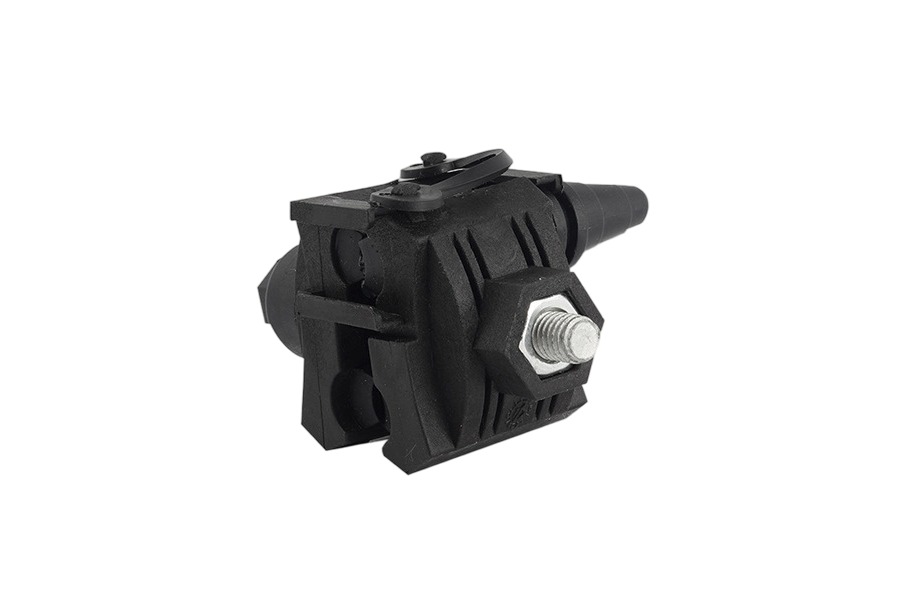
Engineers rely on insulation piercing clamps to tap lines effectively. Their primary function involves creating reliable electrical connections without stripping cable insulation. Sharp metal teeth penetrate the polymer jacket. They make direct contact with the aluminum or copper conductor inside. This method saves installation time and preserves the cable sealing.
You will encounter several key variations in the field:
Main-to-main connectors link two heavy distribution trunks.
Main-to-branch connectors tap power from a trunk to a service line.
Bare-to-insulated connectors transition legacy bare wires into modern ABC networks.
These components bear the mechanical stress of the cable span. They secure the messenger wire securely to the pole. Suspension clamps hold the cable in a straight line. Tension clamps handle the pulling force at dead-ends or sharp network angles.
Differentiating factors include the gripping mechanism. Wedge-type tension clamps use tension to increase their grip. The harder the cable pulls, the tighter the wedge locks. Bolted mechanisms require manual torque application. Material composition also varies. Vendors offer aluminum alloy bodies or UV-stabilized polymer versions depending on expected loads.
Anchoring hardware secures the tension clamps to physical structures. You will mount them on poles or building facades. They transfer the entire mechanical load from the cable span to the supporting architecture. Failure here brings down the whole system.
Selection requires matching load ratings to the specific pole type. Wood poles require different mounting bolts than concrete or steel poles. Stainless steel banding often serves as a universal mounting solution. It wraps around concrete poles securely without requiring drilled holes.
End points require specialized protection. Cable joints connect two separate lengths of cable. Terminations seal the final cut end of a run. Their function involves maintaining internal moisture barriers. They must also preserve dielectric strength across the connection.
Water ingress destroys underground and overhead networks alike. Quality joints use heat-shrink or cold-shrink technologies. They push out air and form watertight seals. This prevents internal corrosion and subsequent catastrophic failures.
How do you systematically evaluate overhead cable accessories before purchase? You must test them against rigorous mechanical, electrical, and environmental benchmarks. A visual inspection never reveals internal material weaknesses.
Assessing tensile strength remains your first priority. You must determine the specific slip resistance thresholds. Labs pull the clamped cable using hydraulic testing machines. They measure exactly when the clamp releases the wire. The holding force must exceed the maximum expected wind and ice loads combined.
Evaluating housing materials is equally important. Overhead lines constantly vibrate. Wind causes aeolian vibration along the entire span. This high-frequency shaking degrades rigid metals. High-quality polymer housings absorb these shocks better. They resist mechanical shock and vibration without cracking over time.
Electrical safety demands strict dielectric strength testing. A standard benchmark involves a 6kV underwater test. Technicians submerge piercing clamps in a water bath for one minute. They apply six kilovolts of electricity. The clamp must not leak current into the water. This proves the internal sealing prevents water ingress perfectly.
You must also verify low contact resistance. High resistance generates heat under peak loads. Thermal cycling causes components to expand and contract. This eventually loosens the connection and triggers arcing. Premium connectors maintain ultra-low resistance across thousands of thermal cycles.
Constant sunlight destroys standard plastics rapidly. You need UV stabilization for polymer components. Manufacturers blend carbon black or specific chemical stabilizers into the polymer matrix. This prevents brittleness and cracking after years of solar exposure.
Metallic parts face different enemies. Corrosion destroys poorly treated metals in coastal or heavy industrial environments. Salt fog eats through basic zinc coatings quickly. You must demand hot-dip galvanized steel or premium stainless steel hardware. The material selection directly dictates the maintenance schedule.
The following table outlines standard material performance across different environmental stressors.
Component Material | Primary Threat | Protective Treatment | Ideal Environment |
|---|---|---|---|
Standard Polymer | UV Radiation (Sunlight) | Carbon Black Infusion | Moderate to High Sun Exposure |
Aluminum Alloy | Galvanic Corrosion | Anodization or Bimetallic Plates | Urban / Inland Grids |
Carbon Steel | Moisture / Rust | Hot-Dip Galvanization | General Purpose Span Loads |
Stainless Steel (316) | Salt Fog / Chemical Vapors | Natural Chromium Oxide Layer | Coastal / Heavy Industrial |
Mandatory standards protect the grid. You should always look for the EN 50483 series. Other critical frameworks include NFC 33-020 and NFC 33-040. These European standards define exactly how LV ABC accessories must perform. They establish minimum acceptable thresholds for climate aging and mechanical damage.
Beware of self-certified claims. Many factories test their own products internally. Their testing rigs might lack calibration. Always require secondary verification. Third-party testing ensures the data remains unbiased and accurate. It protects your network from inflated performance claims.
Even the best components fail if installed incorrectly. Linemen face numerous challenges operating bucket trucks in harsh conditions. We must address implementation realities directly to safeguard the grid.
Installation requires precise force. Over-tightening severs the internal conductors. It weakens the main trunk line structurally. Under-tightening causes dangerous arcing and high contact resistance. The teeth fail to penetrate the oxide layer of the conductor.
Shear-head nuts solve this problem elegantly. These engineered nuts snap off at a specific torque threshold. The lineman simply tightens the bolt until the head breaks. This guarantees perfect contact pressure every single time. It completely removes human error from the installation process.
Proprietary installation tools create massive supply chain headaches. Your crews might lose a specialized wrench during a storm. If the clamp requires that unique tool, the repair stops entirely. Always ensure specified accessories utilize standard metric or imperial sockets. Tooling compatibility speeds up emergency repairs significantly.
Temperature extremes alter material behaviors. Freezing temperatures make standard polymers stiff. Linemen struggle to bend clamps or snap brackets together. Conversely, extreme heat turns jointing compounds into runny liquids. High-quality products use specialized cold-weather polymers. They remain flexible and workable even below freezing.
Working at height exhausts technicians. Ergonomic design features reduce fatigue and physical risk. Smooth edges prevent glove tears and cuts. Captive hardware designs keep bolts attached to the clamp body. This stops linemen from dropping loose nuts onto the street below. These small features improve safety metrics drastically.
Best Practices:
Always brush bare conductors to remove oxidation before clamping.
Use a torque wrench if shear-head nuts are unavailable.
Train crews on specific product handling prior to field deployment.
Common Mistakes:
Reusing shear-head clamps after initial installation.
Mixing incompatible metals without bimetallic transition plates.
Ignoring maximum span load limits during design phases.
Procurement must extend beyond reading marketing brochures. You need a systematic vendor shortlisting logic. Evaluating the manufacturer protects you from catastrophic project delays.
Never rely solely on in-house data. Request unredacted third-party test reports. Renowned laboratories like KEMA or CESI carry global authority. They subject the components to brutal testing conditions. An authentic KEMA report proves the product actually survives real-world electrical stress.
Assess ISO 9001 compliance thoroughly. You want to see the manufacturer's ability to track production batches. If a specific polymer batch fails in the field, traceability matters. The vendor must identify exactly which shipments contain the flawed material. Good QA systems isolate problems before they cause widespread outages.
Large project rollouts require massive material volumes. Evaluate the vendor's true production capacity. Can they deliver at scale without compromising quality? Peak project phases strain weak supply chains. A trusted partner maintains safety stock and offers transparent lead times.
Complex network rollouts generate unforeseen challenges. The availability of installation training matters immensely. Strong vendors offer field engineering support. They send experts to your site to demonstrate proper techniques. This ensures your initial pilot installations proceed flawlessly.
The chart below outlines a framework for assessing potential hardware vendors.
Assessment Pillar | Basic Vendor (High Risk) | Premium Vendor (Low Risk) |
|---|---|---|
Testing Data | Internal Lab Sheets Only | Unredacted KEMA / CESI Reports |
Quality Tracking | No Batch Numbering | Full ISO 9001 Traceability |
Production Scale | Requires Subcontracting | In-house Manufacturing & Extrusion |
Field Support | Email Support Only | On-site Lineman Training Programs |
Reliable overhead power distribution depends on rigorous component evaluation. You must assess all aerial network accessories against strict mechanical, electrical, and environmental metrics. Overlooking weather resilience or slip resistance guarantees future grid failures. Quality hardware protects public safety and maintains consistent power delivery.
You can take immediate action to improve your network. First, audit your current procurement specifications to identify outdated material standards. Second, demand unredacted third-party test reports from all current suppliers. Finally, run localized pilot installations. Test new clamps and brackets in a controlled span before approving full-scale procurement. These steps secure your network against premature failures.
A: Standard lifespan expectations range from 20 to 40 years. This duration depends heavily on environmental severity and material quality. Premium polymers infused with UV stabilizers resist degradation longer. However, continuous exposure to coastal salt fog or extreme desert heat may push the lifespan toward the lower end of that range.
A: No. IPCs are strictly single-use devices. Proper installation permanently deforms the piercing teeth. Additionally, the shear-head nuts break off to guarantee exact torque limits. Removing the clamp destroys its structural integrity and sealing properties. You must discard and replace them if line adjustments are necessary.
A: You must verify the vendor's specified minimum and maximum cross-sectional area (CSA) range. Every clamp holds a specific diameter tolerance. Furthermore, check the messenger wire diameter limits. A mismatch causes the wedge mechanism to slip under heavy loads or crush the internal conductors completely.
A: This European standard provides a comprehensive, universally accepted testing framework. It specifically addresses LV ABC accessories. The protocols measure resistance to mechanical damage, severe climatic aging, and electrical continuity under load. Specifying EN 50483 ensures your components survive real-world stress scenarios without failing prematurely.
