
Views: 0 Author: Site Editor Publish Time: 2026-08-13 Origin: Site


Outdoor cable deployment represents much more than a basic installation challenge. It acts as a continuous, unforgiving test of network reliability and expenditure management. When overhead lines fall, critical digital services immediately stop. Frequent truck rolls, sudden network downtime, and severe storm damage quickly drain your maintenance budgets. The structural integrity of aerial fiber and coaxial networks depends entirely on your mounting hardware. Load-bearing capabilities and weather-resistant properties define how well these networks endure constant environmental stress. Inferior attachments inevitably lead to rapid physical degradation over time. Standardizing on high-grade aerial cable accessories prevents premature mechanical fatigue. They ensure consistent signal integrity across long spans in diverse climates. This strategic procurement choice delivers a measurable return on investment through drastically reduced maintenance cycles.
Purpose-built aerial cable accessories dictate the lifespan of outdoor network deployments by mitigating wind-loading, ice accumulation, and thermal expansion.
Selecting the correct outdoor cable clamps requires matching environmental stressors (UV, salt fog, extreme temps) with specific material compositions (e.g., UV-stabilized polymers, galvanized steel).
Insulating tension clamps protect structural integrity while isolating sensitive data lines from electrical interference and stray currents.
Evaluating vendor solutions should prioritize verifiable load-rating data, material compliance standards, and installation efficiency over initial unit cost.
Environmental stressors relentlessly attack overhead telecom infrastructure. Wind galloping forces long cable spans into violent, rhythmic dances. This dynamic motion fatigues metal messengers and polymer jackets alike. Ice loading adds massive, unexpected dead weight to suspended spans. A half-inch radial ice buildup can easily quadruple the total tension on your anchor points. Ultraviolet radiation silently breaks down inferior polymer jackets over time. UV rays cause plastics to become brittle and crack. Extreme seasonal temperature shifts cause constant thermal expansion and contraction. You cannot simply ignore these harsh physical realities when designing aerial routes.
Substandard hardware introduces hidden, long-term operational costs. It creates dangerous microscopic bends in fragile fiber optic cores. These micro-bends degrade optical signals drastically and increase attenuation. Cheap, poorly designed grips cause severe jacket chafing in coaxial systems. Constant wind-induced friction slowly grinds away the protective outer layers. Eventually, this constant wear leads to catastrophic tension breaks during storms. Choosing "good enough" hardware essentially guarantees future emergency field repairs.
We must define a high-reliability assembly through strict performance metrics. A successful installation exhibits zero sag drift over a five-year period. Its weatherproofing seals remain entirely intact despite brutal seasonal changes. Operators must maintain strict bend radii under all dynamic load conditions.
Environmental Stressor | Physical Impact on Network | Required Hardware Capability |
|---|---|---|
Wind Galloping | Dynamic kinetic stress, vibration fatigue | High slip strength, vibration dampening |
Ice Accumulation | Extreme static weight load | Superior Minimum Breaking Strength (MBS) |
UV Radiation | Polymer embrittlement, cracking | UV-stabilized material composition |
Thermal Shift | Line expansion and contraction | Flexible gripping mechanisms |
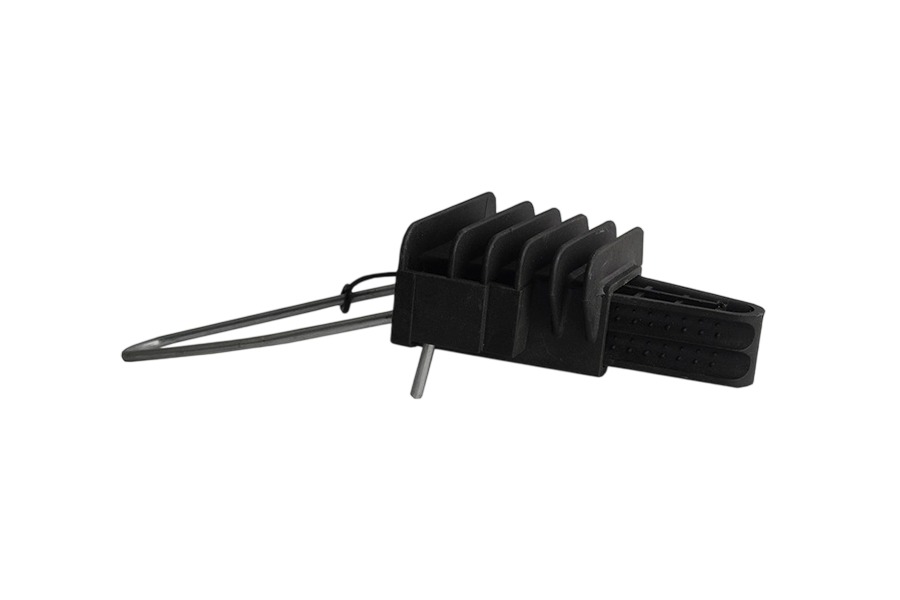
Network engineers rely on specific hardware families to build highly fault-tolerant systems. The right components distribute mechanical stress efficiently across the entire infrastructure.
Outdoor cable clamps play a critical, foundational role in overhead deployments. They grip the suspended line firmly without crushing the delicate outer jacket. You will typically choose between suspension clamps and drop wire clamps based on architecture. Suspension variants support heavier, longer runs between main utility poles. They allow slight longitudinal movement to accommodate thermal expansion. Drop wire versions handle lighter, shorter spans extending directly to customer premises. You must calculate the exact span length and cable weight before selecting a clamp profile. Mismatched clamps frequently cause localized jacket compression and signal loss.
You must securely anchor line terminations to prevent total span collapse. Insulating tension clamps serve as crucial dead-end anchors in these scenarios. They attach securely to building facades, junction poles, or relay stations. Their dielectric properties remain absolutely essential for overall network safety. They physically isolate sensitive data lines from dangerous electrical interference. They also block unpredictable stray currents originating from nearby high-voltage power grids. Utilizing non-conductive materials prevents deadly electrical arcs during severe weather events.
Supplementary management components ensure long-term stability for your passive infrastructure. Terminal connections require robust self-amalgamating tapes and reliable cold-shrink tubing. These specific materials aggressively block moisture ingress at vulnerable splice points. Water inside a connector destroys electrical impedance and ruins optical clarity. Furthermore, UV-resistant labeling helps technicians identify specific lines years after initial deployment. Sturdy cable routing brackets prevent chaotic, tangled messes at junction boxes. Clean routing extends the lifespan of the entire hardware assembly.
Vetting structural hardware requires strict attention to applied material science. You must match the component composition directly to your local environmental stressors. A one-size-fits-all approach never works in global telecom deployments.
Metals and plastics serve vastly different engineering needs in the field. Stainless steel and aluminum alloys offer exceptional tensile strength for heavy lines. They handle massive structural loads effectively in high-stress transit corridors. Conversely, fiberglass-reinforced plastics provide excellent dielectric insulation for sensitive areas. They resist electrical arcing perfectly near municipal power grids. Coastal deployments demand highly corrosion-resistant alloys or advanced polymers. Continuous salt fog quickly destroys standard galvanized steel attachments. Urban industrial zones require specialized plastics immune to airborne chemical pollutants. You must audit your regional climate before finalizing any material specifications.
Rigorous mechanical load testing data separates premium hardware vendors from budget suppliers. You should always request comprehensive Minimum Breaking Strength (MBS) reports. Examine the guaranteed slip strength figures carefully for each clamp model. Dynamic load testing matters far more than simple static load claims. Dynamic tests simulate real-world wind galloping and violent ice shedding. Static tests only measure dead weight in a perfectly controlled laboratory environment. Real-world storms apply complex, multidirectional forces to your aerial accessories. Ensure the vendor tests their hardware under varying temperature extremes.
Authoritative industry compliance provides necessary peace of mind for network operators. Look for strict adherence to established industry standards like ASTM guidelines. Telcordia GR-3120 certifications validate true telecom-grade durability and weather resistance. Ensure your hardware partners clearly state their testing assumptions on specification sheets. Transparent documentation proves they test products under realistic, harsh conditions. Avoid vendors who refuse to share their raw laboratory testing methodologies.
Even premium grade hardware fails quickly if technicians install it incorrectly. Human error introduces massive, unpredictable risks to expensive overhead infrastructure. Training your field teams remains just as critical as buying good parts.
Handling and tensioning mistakes happen frequently during rushed field deployments. Over-tensioning places immense, unnecessary strain directly on the cable jacket. It accelerates fiber micro-cracking and eventually breaks the internal messenger wire. Under-tensioning creates excessive, dangerous sag between your support poles. Loose lines suffer from severe wind whip during heavy seasonal storms. This violent dynamic motion eventually snaps the core data conductors. Installers must use calibrated tensioning tools to achieve the exact engineered sag.
Proper clearance and separation save technician lives and protect expensive equipment. Engineers must maintain strict, legally mandated distances from high-voltage electrical lines. You should always utilize insulating tension clamps to maintain safe mechanical gaps. They prevent accidental arcing during high-wind events or falling tree strikes. Proper spatial separation also reduces electromagnetic interference in unshielded copper lines.
Weatherproofing execution demands precise attention to detail at every single node. Connection nodes represent the most common points of catastrophic network failure. Capillary action pulls water deep into poorly sealed optical closures. You should avoid standard vinyl electrical tape entirely for outdoor applications. It degrades rapidly under direct sunlight, loses adhesion, and peels away.
Follow these proven, evidence-oriented weatherproofing best practices:
Clean the connector surface thoroughly using approved 99% isopropyl alcohol.
Apply a primary overlapping layer of sticky butyl mastic tape.
Install a high-quality cold-shrink tube across the entire mechanical junction.
Ensure the weather seal extends at least two inches past the connector base.
Apply a final UV-protective tape wrap if shrink tubing remains unavailable.
Strategic purchasing goes far beyond simply examining the lowest initial invoice price. Smart procurement models balance immediate capital expenditures against future operational efficiency.
Capital and operational expenditure considerations drive highly intelligent network design. Investing a marginal percentage more in premium accessories pays off exponentially. It drastically reduces emergency field repairs caused by unexpected storm damage. Fewer emergency truck rolls mean significantly lower monthly maintenance budgets. Premium hardware essentially funds itself by preventing revenue-draining catastrophic network outages. Cheap hardware saves pennies upfront but costs thousands in repair labor later.
Long-term scalability depends heavily on strict regional hardware standardization. Standardizing your mounting gear across all deployments simplifies internal operations immensely. It streamlines contractor training because field crews use identical grips everywhere. Inventory management becomes incredibly efficient across massive warehouse networks. Quality assurance inspectors can easily identify proper, standardized installations across thousands of miles. You eliminate the confusion caused by mixing incompatible brand systems.
Procurement teams should take specific, calculated actions to optimize their supply chain. You must evaluate empirical field data before permanently switching hardware vendors.
Audit your current regional failure rates and historic storm data.
Identify specific transit nodes requiring upgraded dielectric insulation or enhanced weatherproofing.
Request physical engineering samples from your top shortlisted manufacturing partners.
Demand verifiable salt-spray test reports and dynamic pull-test documentation before signing contracts.
Conduct a small-scale pilot deployment in your harshest local micro-climate.
Overall network reliability remains only as strong as its weakest physical attachment point. You simply cannot afford to compromise on critical structural mounting hardware. Proper specification of external grips and tensioning gear represents a strategic engineering decision. It should never function as a last-minute, budget-driven installation afterthought. High-quality components shield your digital assets from relentless environmental destruction.
Take immediate, calculated action to safeguard your expanding infrastructure. Review your current active bill of materials today for potential vulnerabilities. Consult your internal engineering teams regarding recent field failure data and outage reports. Reach out to a specialized manufacturer to obtain environment-specific hardware recommendations immediately.
A: Premium UV-stabilized polymers typically last 15 to 20 years. The exact lifespan depends heavily on local environmental variables. Constant exposure to intense solar radiation accelerates chemical degradation. Extreme temperature swings also weaken the polymer matrix over time. You should always select material compositions specifically rated for your regional climate zone.
A: They provide critical dielectric properties completely lacking in pure metal fixtures. These specialized components electrically isolate the messenger wire from terminal poles. This isolation prevents dangerous galvanic corrosion between dissimilar metals in wet environments. They also protect field technicians by actively blocking unpredictable stray electrical currents.
A: Generally, no. Fiber optic lines require specialized grips to prevent internal micro-bending. They have much stricter crush-resistance limits compared to heavily shielded coaxial lines. Applying a heavy-duty coaxial grip to a fiber jacket often destroys the delicate glass core. Always match the hardware perfectly to your specific cable specifications.
A: Human error during installation represents the absolute leading cause of failure. Technicians frequently apply improper torque to securing bolts under tight deadlines. Mismatched clamp sizes also allow lines to slip dangerously under heavy wind loads. Proper crew training remains just as important as selecting premium hardware.
