
Views: 203 Author: Stephen Liu Publish Time: 2026-11-11 Origin: Site


A double hole bimetallic cable lug is most useful when the equipment pad is designed for a matching two-hole interface and rotation control matters. Two separated attachment points can constrain palm movement and define a more stable load path, but only when hole geometry, support area, conductor routing, and installation are coordinated. MINGXU identifies DTL-2 as a double-hole, round-head lug using 1070 aluminum, T3 copper, and a friction-welded transition.
The counterintuitive point is that the second hole is not evidence of “more conductivity.” Current transfer, mechanical restraint, and interface quality are related but different questions. The clearest engineering reason for a two-hole layout is often anti-rotation and load-path control—not an unsupported promise that extra hardware automatically improves every electrical result.
A single attachment point can allow rotation unless the wider assembly constrains the palm. A two-hole pattern can limit that degree of freedom by locating the palm at two separated points.
That benefit appears only when the receiving pad has the correct matching pattern and enough support area. Adding a second hole to an incompatible or undersized landing surface does not create a controlled interface.
Treat the palm, equipment pad, fasteners, cable direction, and supports as one load path. The lug should not be evaluated as an isolated metal shape.
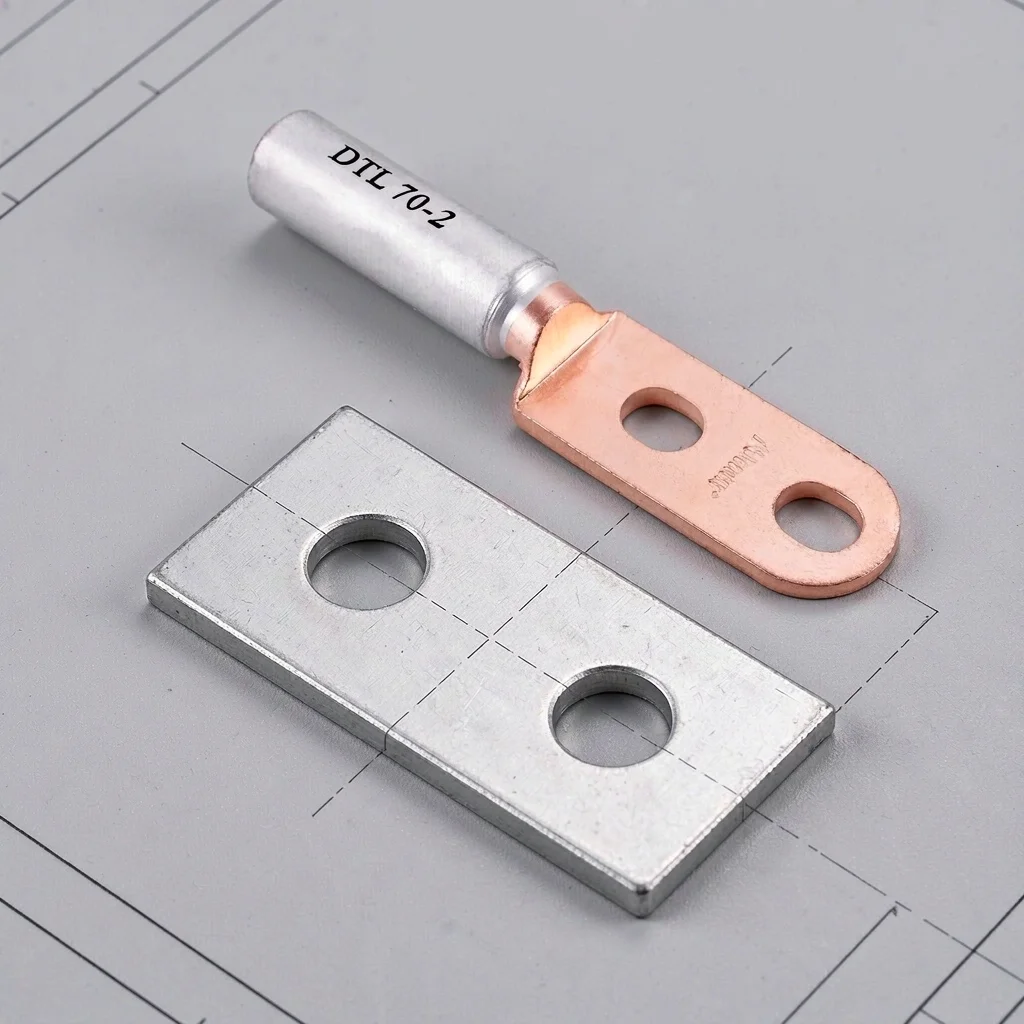
Reference-based illustration: review the double-hole palm against the actual equipment pad pattern before treating anti-rotation as controlled. No dimensions, ratings or certifications are implied.
Obtain the current pad drawing and record hole centers, usable landing area, orientation, obstructions, back-side access, and any equipment-specific assembly instructions.
Overlay the proposed DTL-2 outline and conductor centerline. Confirm that both holes can align without forcing the palm and that the round head remains fully supported.
Never assume “double hole” is a universal pattern. The product family name does not establish the geometry required by a particular project; the applicable drawing must do that work.
MINGXU’s DTL-2 product information identifies 1070 aluminum and T3 copper. Those material statements belong specifically to DTL-2 and should not be copied to other cable-lug families without their own evidence.
Use the product drawing, purchase specification, and supplier documentation to maintain material identity through procurement and inspection.
The same DTL-2 information identifies a friction-welded transition. This is a verified construction description, not permission to infer unlisted resistance, strength, service life, or certification.
Define any project inspection or documentation requirement for the transition explicitly. Avoid inventing visual acceptance limits that are not supported by the approved quality plan.
Ask why rotation matters in the particular assembly. Possible project concerns include maintaining phase spacing, keeping the cable on its support line, preserving cover clearance, or preventing movement during service work.
Translate that concern into observable criteria on drawings and during the mock-up. “Anti-rotation” is useful only when reviewers can determine whether the installed configuration actually controls the intended movement.
Check whether cable forces can still twist the assembly despite two fasteners. Poor routing or support can place unwanted load into the terminal even when the palm itself is well located.
Use the two-hole arrangement to discuss positioning, restraint, and load distribution at the interface. Do not convert those mechanical observations into an automatic electrical-performance claim.
Electrical suitability must rest on the project’s approved product data, equipment interface, conductor match, installation process, and required test evidence. Hole count alone cannot supply that evidence.
This separation improves specifications. It lets engineers demand anti-rotation where needed without writing vague statements such as “two holes are always more conductive” or “double hardware is always more reliable.”
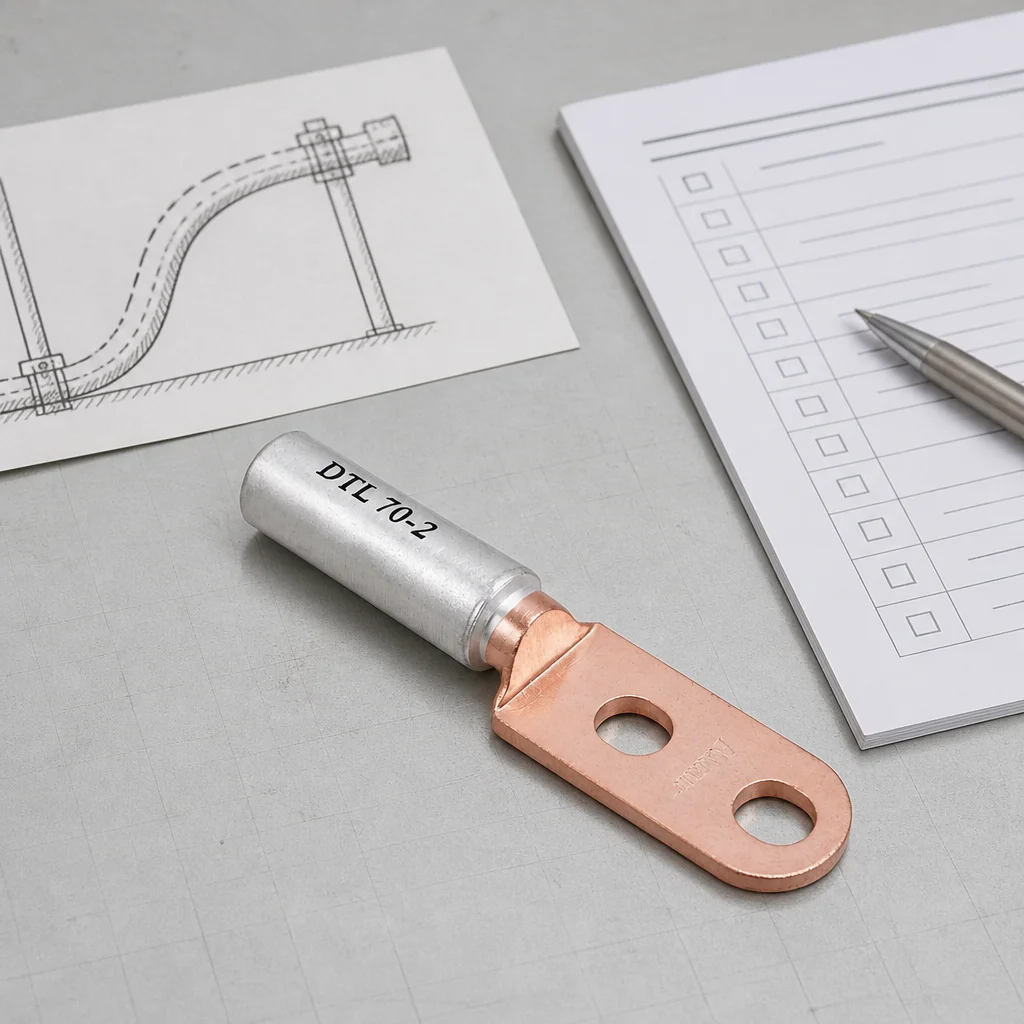
Reference-based inspection scene: cable route, support, drawing identity and acceptance evidence should be reviewed together rather than inferred from the presence of two holes.
Draw the conductor approach relative to the two-hole axis. A cable that pulls across the axis may introduce a different load pattern from one aligned with the palm and support arrangement.
Locate support so normal cable forces do not rely on the terminal hardware. Include assembly access and future removal when choosing the support position.
Review thermal movement, vibration, or other project conditions only through the applicable engineering process and evidence. Do not assign unverified performance values to DTL-2.
Two holes reduce rotational freedom, but they also make pattern mismatch immediately important. Review tolerance information from the controlled pad and lug drawings rather than checking nominal centers only.
Plan how the palm is presented to the pad and how hardware is installed. The sequence should allow both holes to align naturally without levering the lug into place.
If assembly requires force to overcome misalignment, stop and investigate. A forced fit can conceal a drawing mismatch, part mix, distorted component, or accumulated tolerance problem.
Exact equipment pad drawing and revision
Proposed DTL-2 variant drawing
Conductor description and routing sketch
Material identity: 1070 aluminum and T3 copper
Friction-welded transition description
Installation and inspection documents
Sample-review and traceability requirements
Keep facts, requirements, and open questions in separate columns. This prevents a request for evidence from being misread as evidence already supplied.
Do not state that DTL-2 has a particular product certification unless the project receives and verifies applicable documentation. Company-level statements on the MINGXU site do not replace product-level evidence.
At receipt, match product and batch identification to approved documents. Review visible condition, hole pattern, landing surface, and configuration against the drawing and project plan.
During assembly, confirm that the palm seats as designed, both holes align naturally, cable routing follows the approved path, and barriers or covers can be restored.
Use supplier instructions and the project quality plan for acceptance. Do not create universal dimensional, torque, thickness, or weld-appearance limits when the verified facts do not provide them.
Recheck if the equipment pad or hole pattern changes.
Recheck if the conductor or route changes.
Recheck if the DTL-2 variant or drawing changes.
Recheck if hardware, barriers, or supports change.
Recheck if the approved installation process changes.
A two-hole connection is sensitive to interface configuration. Copying approval to a revised pad because it “still has two holes” ignores spacing, orientation, support area, and access.
Keep the final decision record with the panel or project documentation. The record should explain why anti-rotation was needed and how the approved layout provides it.
Define the review boundary explicitly. The DTL-2 construction facts establish material and transition identity, while the project documents establish conductor compatibility, pad fit, installation method, hardware arrangement, and acceptance. Keeping those evidence layers separate makes the approval easier to audit.
For a first build, witness the complete sequence from part identification to barrier restoration. Watch whether both holes align before hardware draws the palm into place and whether cable support is installed without shifting the termination. Record observations against the drawing rather than relying on a general “looks good” result.
If a mismatch appears, preserve the evidence before disassembly: photograph the orientation, capture the part and pad identities, and quarantine affected components where required. The investigation can then distinguish an incorrect part, drawing revision, manufacturing variation, or layout error.
Feed the conclusion back into purchasing and production controls. A corrected drawing reference, clearer label, dedicated storage location, or added witness point often prevents recurrence more effectively than telling assemblers to be more careful.
This approach also protects the unique engineering case for a double-hole lug. It demonstrates that the second attachment point was selected to manage a defined motion and load path, rather than added as decorative hardware or used to support an unverified electrical claim.
Maintenance documentation should retain that design intent. A future technician needs to know that orientation and both attachment points are part of the approved restraint strategy, not optional details. The service plan should reference the applicable product and equipment instructions for disassembly and restoration.
Review spare-part controls as well. A replacement described only as a “two-hole bimetal lug” may not preserve hole geometry, conductor compatibility, material identity, transition construction, or envelope. Use the approved DTL-2 variant and drawing identity in spare procurement.
When project conditions evolve, distinguish a like-for-like replacement from a redesigned interface. If the pad, conductor, route, support, or installation process changes, repeat the affected approval steps. The visible presence of two holes is not enough to claim equivalence.
Close the lifecycle loop with field observations. If a termination moves, conflicts with a cover, or becomes difficult to service, investigate the complete load path and configuration. Preserve photographs, part identity, drawing revisions, cable support details, and installation records before changing the assembly.
Translate the finding into a specific control. Update the routing drawing, pad interface note, spare description, sample requirement, or inspection point. This makes anti-rotation a managed design intent from procurement through service rather than a one-time assumption at initial selection.
MINGXU identifies 1070 aluminum and T3 copper for its DTL-2 double-hole bimetallic cable lug. These specific material facts should not be generalized to other product families.
MINGXU describes the DTL-2 aluminum-to-copper transition as friction welded. That construction description does not by itself establish unlisted performance values or certifications.
No. The strongest defensible reason discussed here is control of rotation, positioning, and load path when the equipment pad matches. Electrical suitability requires separate project evidence.
No universal compatibility should be assumed. Compare the exact lug and pad drawings, conductor, routing, support area, hardware, access, and project requirements.
If anti-rotation is important in your termination layout, share the two-hole pad drawing, conductor description, cable route, support concept, and document requirements with MINGXU. A DTL-2 review can then focus on the verified construction and the actual interface—without inventing ratings, dimensions, or approvals.
