
Views: 86 Author: Stephen Liu Publish Time: 2026-11-09 Origin: Site


In a pin type cable lug vs ring lug decision, the equipment terminal is the first filter. Choose a pin-type termination only where the receiving equipment is designed for a pin input; choose a palm-type form where the equipment provides an appropriate bolted landing surface. MINGXU identifies PBL as a pin-type copper-aluminum transition terminal. That identity does not make it a universal replacement for a palm lug or establish unlisted specifications.
The counterintuitive conclusion is that this is not a quality ranking. A palm is not automatically more industrial, and a pin is not automatically better for small spaces. Each can be the cleaner choice when it matches the receiving interface; each can become a layout and process problem when used to imitate the other.

Image composition based on supplied product photographs: a copper pin end and a copper palm with a bolt hole. Appearance alone does not establish equipment compatibility; confirm the receiving interface against approved drawings.
A pin-type terminal presents a pin-shaped end to equipment designed to accept that form. Its approval therefore depends on the receiving terminal’s documented acceptance of the pin geometry and the planned installation method.
A palm-type lug presents a flat landing feature intended for a bolted interface. The equipment pad, hole arrangement, support area, orientation, and fastening system become central to compatibility.
Use “ring lug” carefully in specifications because market language varies. A drawing and explicit interface description are more reliable than a familiar nickname.
Record the exact device and terminal option, then obtain the current connection drawing. Identify whether the interface accepts a pin or provides a bolted landing surface.
Reject any proposal that changes interface type without equipment approval. Inserting an improvised adapter, reshaping a part, or treating a pin as a makeshift palm creates a configuration outside the original selection.
When several device options exist, compare the complete assemblies. The most compact terminal on paper may require an accessory or access path that changes the final board layout.
MINGXU lists PBL as a pin-type copper-aluminum transition terminal. This supports its product identity and intended form, but it does not publish every selection parameter needed for a project.
Do not infer conductor range, current capability, pin dimensions, tightening values, material grades, or certification status from the model label. Request the applicable product drawing and project evidence.
Preserve this distinction in purchasing language: describe the needed interface, then reference the approved PBL variant after review. Avoid using the family name as the entire specification.
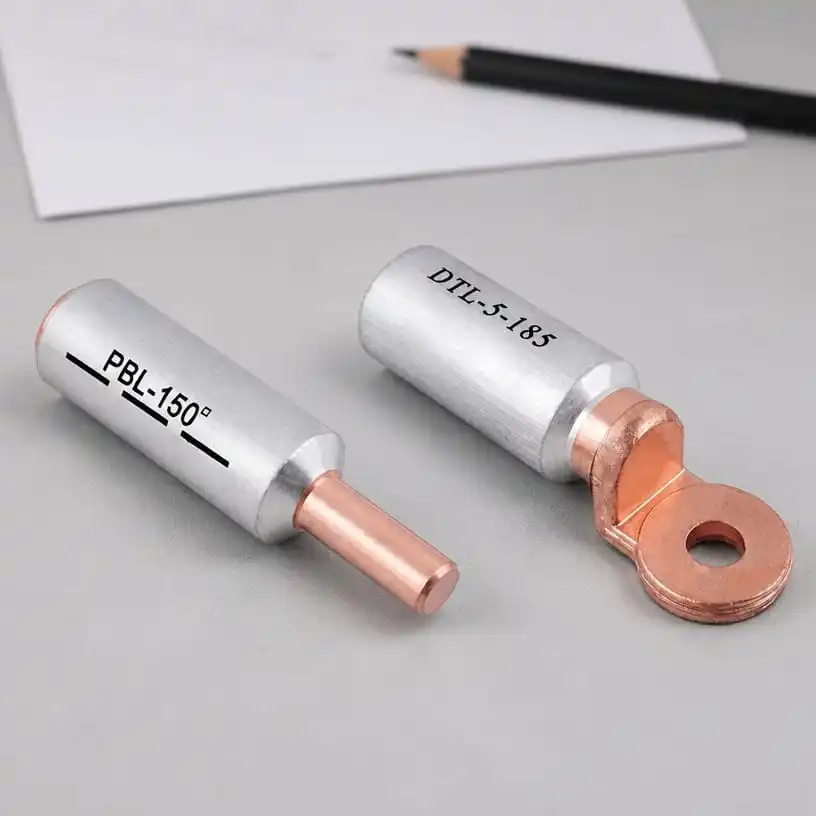
Product-photo-based composition for pre-installation review. Check the complete barrel and connection end together with cable approach, barriers, tool access and service space; no dimensions or ratings are implied.
A pin can reduce the need for a broad palm landing area, yet its barrel and cable approach still require room. Measure the whole termination rather than focusing on its narrow end.
Check the depth needed for full insertion under the equipment’s instructions and retain access for installation and inspection. Do not assume a narrow visible end means a small overall envelope.
A palm may occupy more visible surface at the device but can align naturally with a busbar or terminal pad. Its fastener and tool approach add another volume that must remain accessible.
Model neighboring phases, wireways, doors, and removable covers. Compact boards fail spatially when designers count unused air but ignore installation and service envelopes.
Trace the conductor from support to terminal for both options. Compare how each termination aligns with the natural cable path and whether it introduces twist near the equipment.
Do not ask the terminal to serve as the cable support. A neat-looking bend can still transfer mechanical load if the support arrangement is remote or installed in the wrong sequence.
Consider removal and reconnection. A termination that saves initial space but traps the cable behind other components may not be the better lifecycle choice.
List every controlled step for each interface: conductor preparation, termination, positioning, equipment fastening or clamping, inspection, and cover restoration.
Identify the tools and evidence required by approved instructions. Settings must come from supplier and equipment documentation, never from a generic value repeated across unrelated products.
Choose the option that the production environment can execute consistently. Familiarity matters only when supported by training, suitable tools, and inspection—not when it excuses undocumented habits.
Confirm the correct terminal identity, proper insertion and seating according to the equipment instruction, undisturbed cable route, restored cover, and required production record.
If the critical interface becomes hidden after assembly, define the witness point or evidence capture before production begins.
Confirm approved orientation, flat landing, hardware arrangement, absence of interference, cable support, and restored barriers or covers.
For both forms, retain batch and assembly records as required by the project. A final appearance check cannot reconstruct which parts, tools, and instructions were used.
Receiving terminal type and drawing revision
Conductor description and proposed variant
Installed envelope and cable route
Installation tool access and sequence
Inspection visibility and witness points
Service removal strategy
Product identification and supplier documents
Score only evidence-backed criteria. Where data is missing, mark an open item rather than awarding a neutral score that hides uncertainty.
Send the same matrix to prospective suppliers so responses address the same interface questions. This converts a vague form-factor debate into a controlled engineering decision.
Build a representative section with the actual device terminal, proposed lug, conductor, nearby components, barriers, and covers. Follow the planned production sequence.
Invite design, manufacturing, and quality reviewers. Each sees different failure modes: drawing conflict, assembly difficulty, and inspectability. Record deviations instead of fixing them informally during the trial.
Document why the selected form won. The decision might favor a pin or a palm, but the durable result is the evidence trail, not a claim that one category is universally better.
Do not substitute solely because two lugs accept a similar conductor description.
Do not assume a compact pin guarantees a compact installed system.
Do not use a palm where the equipment documents call for a pin input.
Do not reshape either interface to make it resemble the other.
Do not transfer company-level credentials to a specific PBL product.
Treat any change of device, terminal accessory, cable, lug variant, enclosure, or routing as a potential reapproval trigger. Interface decisions are configuration-specific.
A disciplined “not enough information yet” is more professional than a confident guess. Request drawings and samples until the project can make a traceable decision.
Create a one-page interface control sheet after approval. Show the device and terminal option, selected termination form, conductor identity, orientation, routing sketch, applicable drawings, tooling reference, inspection point, and prohibited substitutions. A compact sheet makes the decision usable without replacing the underlying controlled documents.
At production launch, ask an assembler unfamiliar with the prototype to follow the released package. If the person must depend on verbal coaching to distinguish the pin and palm configurations, improve the documents before volume work begins. Repeatability is tested by transfer, not by the original designer’s success.
Keep procurement descriptions interface-specific. A request for a “lug for this cable” is incomplete; include the receiving terminal, device revision, envelope restrictions, and evidence list. This wording helps prevent a supplier or buyer from treating pin and palm forms as interchangeable variants.
Finally, review field feedback by configuration. A finding related to a pin-input device should not automatically change the palm-interface process, or vice versa. Preserve enough identity in records to learn accurately rather than generalize from unrelated assemblies.
Include maintenance in the final review. Ask how a technician will identify the termination form, gain access, support the cable, restore covers, and verify the completed work. A compact production arrangement that cannot be serviced without disturbing adjacent connections may impose avoidable lifecycle risk.
Document prohibited adaptations in plain language. If the chosen device expects a pin, do not flatten or drill a pin end; if it expects a bolted palm, do not improvise a clamped pin interface. Unexpected fit problems should stop work and trigger the approved engineering process.
Manage spare parts by approved interface identity. A general label such as “lug for this cable” cannot distinguish the equipment-facing geometry, device option, envelope, or required installation process. Spare records should point to the same drawings and restrictions used for production.
When investigating a service issue, capture the entire connection before replacing the termination. Record the device terminal, lug form, conductor route, support, covers, visible condition, and available installation history. That context prevents a pin or palm category from receiving blame for an unrelated system problem.
Use lessons to update the comparison matrix. Better questions about access, identification, routing, or inspection can improve the next compact-board design without claiming that one form has become universally superior.
MINGXU identifies PBL as a pin-type copper-aluminum transition terminal. This article does not assign it unverified dimensions, ratings, material grades, installation values, or certifications.
No. Its narrow end may suit a pin-receiving terminal, but the barrel, cable path, insertion depth, tool access, covers, and service needs determine the installed envelope.
A palm-type form is logical where the receiving equipment provides an appropriate bolted landing interface and the approved lug fits the conductor, pad geometry, space, and installation process.
Not on conductor similarity alone. The receiving interfaces are different. Any substitution needs equipment and lug documentation, spatial review, installation planning, and project approval.
If your board design is deciding between a pin input and a bolted landing interface, send MINGXU the device drawing, conductor description, enclosure model, route, and evidence requirements. A focused PBL or palm-type proposal can then be reviewed against the real terminal instead of a generic preference.
