


DTL-3
Mingxu


Utilizing advanced friction welding technology, this lug creates a molecular bond between its aluminum conductor barrel and copper terminal section, ensuring optimal electrical conductivity and mechanical strength. Compliant with IEC 61238-1 and AS/NZS 4325.1 standards, it supports conductor cross-sections from 16 mm² to 630 mm² in low to medium-voltage systems (up to 10 kV). Its versatile design makes it suitable for diverse applications where reliable transitions between aluminum cables and copper busbars or equipment terminals are required, combining the cost-effectiveness of aluminum conductors with the connectivity advantages of copper.
The lug features a 99.6% pure aluminum barrel optimized for crimping to aluminum conductors and a 99.9% electrolytic tough pitch (ETP) copper terminal section for superior connectivity to copper components. This material combination balances conductivity with cost efficiency, providing 60% IACS conductivity in the aluminum section and 97% IACS in the copper section for minimal power loss.
The aluminum-copper joint is created using high-integrity friction welding, producing a metallurgical bond with tensile strength exceeding 150 MPa and resistivity ≤1.5 µΩ·cm across the transition zone. This process eliminates electrolyte gaps that cause galvanic corrosion in mechanically joined bi-metal connections, ensuring long-term performance in corrosive environments.
The aluminum barrel comes pre-filled with a specialized anti-oxidation compound that breaks down oxide layers on aluminum conductors during crimping, ensuring intimate metal-to-metal contact. This compound maintains its effectiveness over time, preventing re-formation of high-resistance oxide films that can degrade connection performance.
Engineered to perform reliably across a temperature range of -40°C to 110°C, the lug accommodates thermal cycling in outdoor installations and industrial environments without mechanical degradation or increased resistance. This temperature tolerance ensures consistent performance in both cold climate utility applications and hot industrial settings.
Electrical contractors utilize the lug for connecting aluminum feeder cables to copper busbars in distribution panels and switchgear, ensuring code-compliant transitions in commercial buildings, hospitals, and data centers where reliable power distribution is critical.
In electrical distribution systems, the lug creates secure connections between aluminum service drops and copper transformer terminals, supporting efficient power delivery from utility grids to commercial and residential facilities. Its corrosion resistance makes it suitable for both urban and rural installations.
Manufacturing facilities employ the lug for connecting aluminum power cables to copper terminals on motors, generators, and control equipment, providing reliable power transmission in environments with vibration and temperature fluctuations.
The lug facilitates connections between aluminum collection cables and copper inverter terminals in solar farms and wind energy installations, supporting the growing demand for renewable energy integration with existing power infrastructure.
Installation requires hexagonal crimp dies specifically designed for bi-metal connections, used with hydraulic crimping tools capable of delivering 12-30 tons of force depending on lug size. Tools must meet ISO 6722 standards to ensure proper deformation and connection integrity.
The friction welding process creates a continuous metallurgical bond without electrolyte gaps, while an intermetallic compound layer (≤5 µm thickness) formed during welding acts as a diffusion barrier between copper and aluminum, eliminating galvanic action that causes corrosion in mechanical connections.
No, the lug is designed for one-time crimp installation only. Once crimped, the aluminum barrel forms a permanent deformation around the conductor that cannot be safely reversed. Attempting to reuse the lug may result in high-resistance connections or mechanical failure.
Each production batch undergoes rigorous testing in accordance with IEC 61238-1 and AS/NZS 4325.1 standards, including heat cycling tests, mechanical pull tests, and conductivity verification to ensure consistent performance and reliability in field applications.
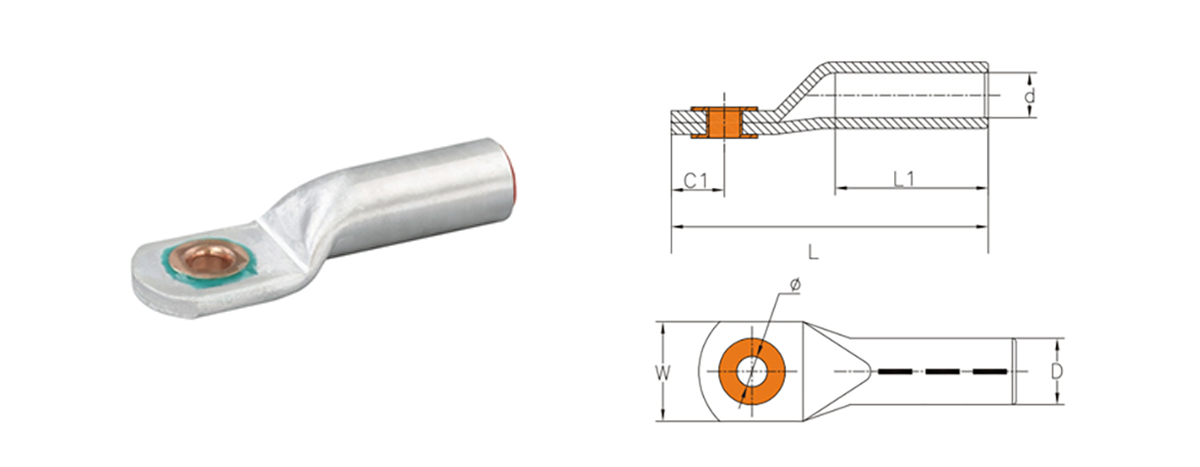
| Item No. | D±0.2 | d±0.2 | φ±0.3 | C1±1 | L±2 | W±0.2 | Package (pcs) | Gross weight (kg) |
| DTL-3-35 | 14 | 8.5 | 10.5 | 14.9 | 82 | 25 | 960 | 25 |
| DTL-3-50 | 16 | 10.0 | 10.5 | 14.5 | 87 | 27 | 600 | 22 |
| DTL-3-70 | 18 | 11.5 | 13.0 | 17.2 | 102 | 32 | 480 | 24 |
| DTL-3-95 | 21 | 13.5 | 13.0 | 19.6 | 106 | 35 | 240 | 21 |
| DTL-3-120 | 23 | 15.0 | 13.0 | 16.5 | 112 | 35 | 240 | 22 |
| DTL-3-150 | 25 | 16.5 | 13.0 | 18.9 | 125 | 35 | 180 | 19 |
| DTL-3-185 | 28 | 18.5 | 13.0 | 22.0 | 133 | 42 | 120 | 17 |
| DTL-3-240 | 32 | 21.0 | 17.0 | 26.2 | 140 | 46 | 120 | 22 |
| DTL-3-300 | 34 | 23.5 | 17.0 | 26.0 | 155 | 50 | 90 | 19 |
| DTL-3-400 | 38 | 26.5 | 17.0 | 30.0 | 170 | 58 | 72 | 23 |


