
Views: 0 Author: Stephen Liu Publish Time: 2026-08-31 Origin: Site


Every utility-scale solar plant contains thousands of terminations, but one connection type causes a disproportionate share of thermal defects found at commissioning: aluminium feeder cable landed directly on copper equipment terminals without a bimetallic transition. The fix is known, cheap and boring — friction-welded copper-aluminium cable lugs — which makes it all the more remarkable how often inspections still find it missing.
This article maps where lugs sit in a PV plant's electrical chain, which type belongs at each point, and the specification and commissioning practices that keep connection resistance off your O&M ticket list.
Three characteristics make PV plants harder on connections than conventional distribution:
1. Daily deep thermal cycling. A feeder termination in a substation sees relatively steady load. A PV combiner or inverter termination goes from cold pre-dawn to full current at solar noon, every single day. Thirty years of service means roughly 10,000 major thermal cycles — precisely the stress that loosens marginal joints. IEC 61238-1's 1,000-cycle heat test exists for exactly this failure mode, which is why type-tested lugs matter more in solar than almost anywhere else.
2. Aluminium economics are unavoidable. The sheer cable volume of a solar field — kilometres of DC trunk and AC feeder runs — makes aluminium conductor the rational choice, and the industry has followed. But inverters, transformers, switchgear and combiner busbars present copper or tinned-copper terminals. The result: a plant of ten megawatts contains hundreds of aluminium-to-copper interfaces, each one a galvanic corrosion site unless properly transitioned.
3. Outdoor exposure with minimal supervision. Terminations live in combiner boxes and skid enclosures across a large fenced field, seen by humans perhaps once a year. Joints must be right the first time; there is no busy switchroom where a hot smell gets noticed.
String cabling is typically copper, 4–10 mm², terminated with connectors rather than lugs. Lugs enter the picture at combiner boxes, where harness or string conductors land on busbars — copper tube lugs (SC or DT type) for copper conductors, sized to the actual strand class since flexible conductors are common here.
This is aluminium territory: conductors commonly from 95 mm² up to 400 mm². Two correct configurations:
Aluminium conductor onto aluminium busbar: DL or AU series aluminium lugs, 1070-grade annealed aluminium, barrels pre-filled with oxide-inhibiting grease.
Aluminium conductor onto copper or tinned-copper terminal (the common case at inverter DC inputs): DTL-series bimetallic lugs with a friction-welded copper palm on an aluminium barrel. The welded transition moves the dissimilar-metal interface away from the bolted contact and provides a continuous copper-to-aluminium transition designed to maintain low, stable joint resistance.
AC feeders from central inverters to the MV transformer are large aluminium conductors — 240 to 630 mm² is routine. The same logic applies: bimetallic DTL or ACL lugs at every copper terminal. The ACL geometry, with its narrow palm profile, suits moulded-case breaker and compact terminal windows where a standard palm won't physically fit.
Copper earthing conductors take standard copper lugs; where earthing copper bonds to aluminium structures (module frames, trackers), the bimetallic rule applies in reverse. Corrosion at bonding points doesn't trip a plant, but it quietly invalidates the earthing design — worth a line item in the inspection plan.
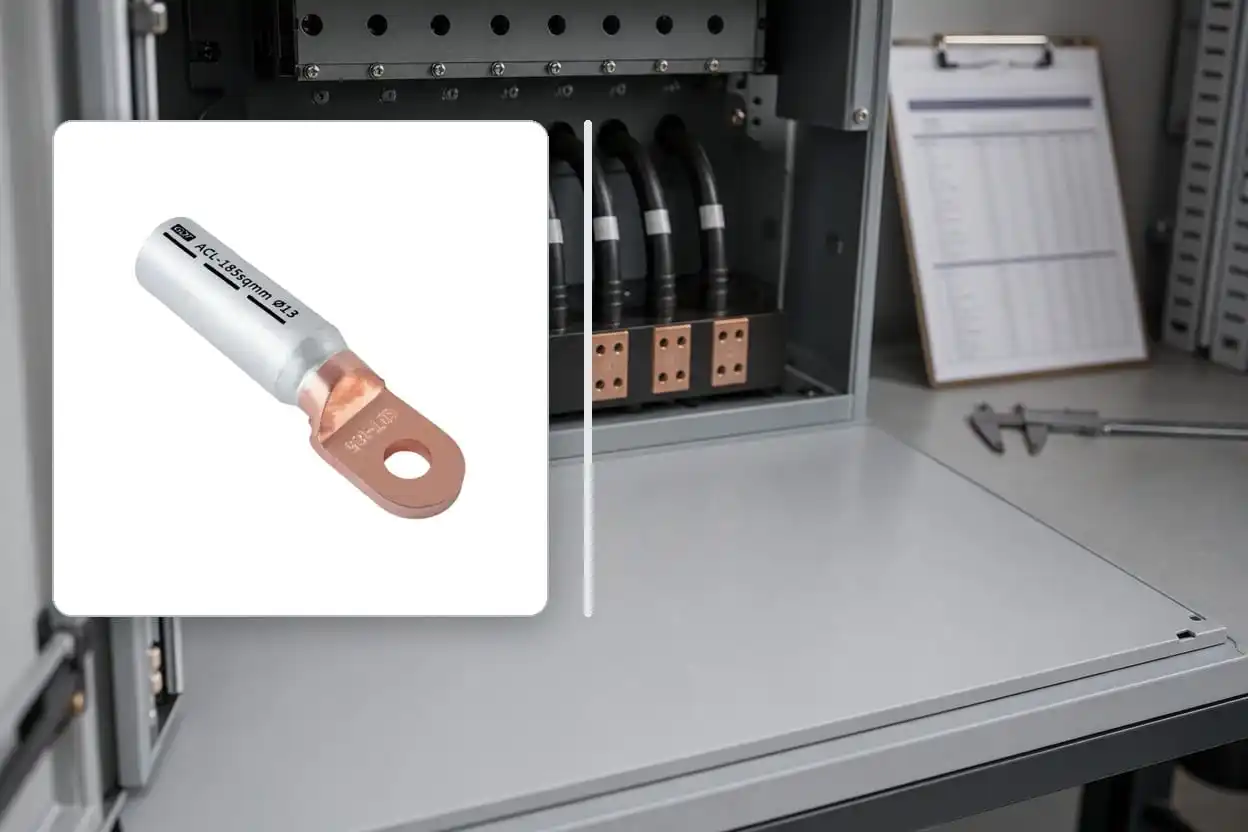
The aluminium barrel accepts the feeder conductor while the copper palm mates with the inverter terminal.
From reviewing procurement specs across export solar projects, these five clauses separate a tight specification from a decorative one:
1. Name the standard and class. "Compression lugs type-tested to IEC 61238-1" — not "high quality lugs." For European-destination projects, CE marking on the documentation chain.
2. Fix the material grades. T2/T3 copper for copper parts and 1070-grade aluminium for aluminium barrels. Where a tin-plated palm is specified, require the coating and finish to match the approved sample and supporting test documentation. Material substitutions should trigger a fresh engineering review.
3. Require friction-welded transitions — by name. "Bimetallic" alone does not describe the joining process. Specify a friction-welded copper-aluminium transition and reserve the right to review sectioned samples, weld quality records or applicable type-test evidence.
4. Match the range to the schedule. A typical utility PV plant needs lugs from 10 mm² (control and sensor circuits) through 630 mm² (AC feeders). Sourcing the required range from one qualified product family can simplify documentation and tool control, provided every selected size is covered by the supplier’s approved crimp chart and relevant test evidence.
5. Pre-filled barrels, capped. Aluminium and bimetallic lug barrels arrive greased and capped, or the site team ends up applying compound by hand — inconsistently, in the wind, at 40°C.
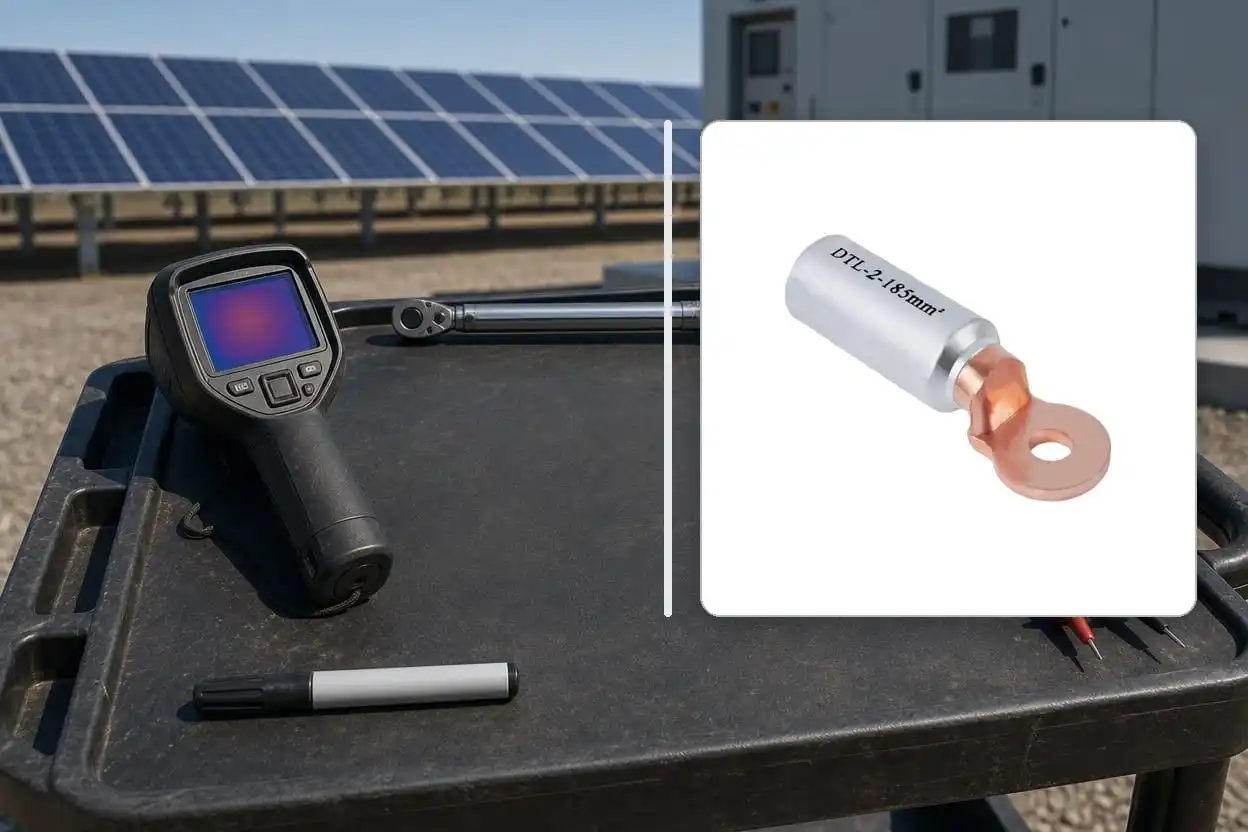
Thermography, torque control and baseline resistance readings help identify weak terminations before handover.
In our experience supplying connection hardware to PV projects, the plants with clean year-one thermography reports did three things during construction:
Crimp-system qualification before mass termination. Three sample crimps per conductor size with the actual site tools; pull test and micro-ohm check. Twenty minutes per size. Catches die mismatches while they cost nothing.
Inspection-window discipline. Every tube lug has a sight hole; every crimped joint gets a visual confirm that the conductor is fully home, then a paint-pen mark. On a plant with thousands of terminations, marked-joint discipline is the only honest answer to "were they all checked?"
Baseline micro-ohm measurements on the large terminations. AC feeder and transformer connections measured at commissioning give O&M a comparison point. A joint reading 40% above its phase neighbours in year three is a trend; without the baseline it's a guess.
The counterintuitive economics: on a utility-scale plant, upgrading every aluminium-to-copper interface from an improvised connection to a proper friction-welded bimetallic lug costs a rounding error of the EPC contract — while connection-level defects are repeatedly identified during commissioning and thermographic inspection. Few line items in the entire project buy more availability per dollar.
Solar sites are dusty, hot and stretched over kilometres — hardware handling deserves two sentences of process:
Keep lugs bagged and barrels capped until the minute of use. A barrel full of laterite dust defeats the factory grease.
Store crimping dies with the lugs they match, not in a central container. Mixed-die errors multiply when tools travel between block crews.
DC-side flexible cables (Class 5) appear in combiner boxes and inverter rooms where routing is tight. A Class 5 conductor of a given mm² is fatter than the Class 2 conductor the standard lug barrel expects. Forcing it sheds strands; every lost strand is lost cross-section at the joint. Order flexible-conductor lugs for those locations — the schedule review takes minutes and the alternative shows up as warm joints under full irradiance.
To make the mapping concrete, here is the lug profile of a representative 10 MW block, expressed as categories rather than exact counts:
Combiner boxes: copper SC/DT lugs, 10–35 mm², flexible-conductor bores where Class 5 cable is routed — hundreds of pieces.
DC trunk to inverter: DTL bimetallic lugs, 150–400 mm², one per conductor end at every copper-terminal interface — the largest single category on most sites.
Inverter AC to transformer: DTL/ACL bimetallic, 240–630 mm², double-hole palms where the transformer LV flags are drilled for two bolts.
Auxiliary and control circuits: small copper lugs, 10–25 mm², easily forgotten in ordering and always needed in twice the estimated quantity.
Earthing network: copper lugs across sizes, plus transition fittings at aluminium structure bonds.
Two ordering rules from experience: add a genuine spares margin (site damage and training crimps consume more than office estimates allow), and order the odd sizes — reduced neutrals, auxiliary circuits — explicitly rather than assuming the main-size order covers them.
Do DC-side lugs differ from AC-side lugs?
Electrically, a compression lug does not care about waveform — the same IEC 61238-1-tested hardware serves both sides at LV. The differences are situational: DC combiner circuits more often use flexible Class 5 conductor (bore accordingly), and DC fault-clearing behaviour makes stable joint resistance even more valuable, since a degrading DC joint sustains arcs more readily than an AC one.
Can tinned copper lugs handle the outdoor environment without extra protection?
Tin plating can support oxidation resistance, but it is not a substitute for the enclosure’s environmental rating, clean mating surfaces or a compatible metal transition. Direct copper-to-aluminium contact remains the first issue to eliminate; the complete termination should then be protected to the project’s outdoor exposure requirements.
What about torque marking on solar sites?
Strongly recommended. A paint stripe across bolt head, palm and busbar after final torquing gives every future inspection a one-glance loosening check across thousands of joints — the kind of low-tech discipline that scales far better across a solar field than any instrument-based survey.
Who should hold the crimping records — EPC or owner?
Both, ideally: the qualification records (die codes, test crimps, pull-test results per size) belong in the handover documentation package alongside the lug type-test reports. Plants change O&M contractors; the termination records are the part of the electrical as-built that gets asked for in year five and cannot be reconstructed.
Solar plants concentrate the hardest conditions for electrical connections — deep daily thermal cycling, mass aluminium-to-copper interfaces, and outdoor neglect — into one asset class. The countermeasures are equally concentrated: friction-welded bimetallic lugs at every Cu-Al interface, IEC 61238-1 type-tested hardware in fixed material grades (T2/T3 copper, 1070 aluminium), crimp-system qualification, and baseline resistance measurements at commissioning.
If you are preparing the electrical BOM for a PV project, MINGXU can turn your cable schedule into a complete lug schedule — copper SC/DT, aluminium DL/AU and bimetallic DTL/ACL series across 10–630 mm², with CE documentation, applicable IEC 61238-1 test evidence and batch material records available for project review. Send the schedule and the terminal details of your inverter and transformer models; matching them precisely is the part of the job we do every week.
