
Views: 0 Author: Site Editor Publish Time: 2026-07-16 Origin: Site


Terminating aluminum cables to copper busbars presents a serious engineering challenge. You inherently mix dissimilar metals within the same electrical circuit. This combination creates a high risk for galvanic corrosion and severe thermal expansion mismatches. Incorrect termination frequently leads to increased contact resistance at the joint. This rising resistance causes thermal runaway, system downtime, and potential fire hazards. Facilities cannot afford these catastrophic operational failures.
You need an engineered solution to safely bridge these materials. Specialized bimetallic connectors solve this exact problem. They provide a stable, permanent transition between aluminum and copper. We will explore how to evaluate and specify the right components for your specific requirements. You will learn the technical framework necessary to source these vital connections correctly. This guide focuses strictly on industrial and high-voltage applications to ensure your power infrastructure remains reliable and safe.
Bimetallic cable lugs prevent galvanic corrosion and thermal joint failure by utilizing friction-welded aluminum and copper sections.
Specifying the correct lug requires matching the cable cross-section precisely and selecting the appropriate barrel design (e.g., DTL-1 or DTL-2 series) for the application.
Quality evaluation must focus on the integrity of the friction weld, material purity (typically 99.9% Cu and 99.5% Al), and compliance with IEC/UL standards.
Successful implementation relies as much on proper installation procedures—including oxide-inhibiting compounds and correct crimping dies—as on the hardware itself.
Connecting aluminum and copper directly invites immediate failure. Understanding the physics behind this failure helps you appreciate the necessary engineered solutions.
Aluminum and copper react electrochemically when they touch. They sit far apart on the galvanic series. Aluminum acts as the anode, and copper acts as the cathode. Add a simple electrolyte like ambient moisture, and a destructive reaction begins. The aluminum degrades rapidly. It literally sacrifices itself to the copper. This corrosion eats away the contact surface. The joint loses its conductive area, forcing current through a smaller bottleneck. Resistance spikes dramatically as a result.
Power loads fluctuate constantly in industrial environments. Cables heat up during peak demand and cool down during off-peak hours. Aluminum expands and contracts at a significantly faster rate than copper. This differing expansion rate gradually loosens traditional mechanical connections. Over time, the joint loses its clamping force. Loose joints create micro-arcing. They spark, oxidize further, and eventually fail under load.
A specialized Bimetal Crimp Lug for Electrical systems solves these issues directly. Manufacturers permanently fuse the two metals together. They spin the aluminum and copper against each other at high speeds. The intense friction plasticizes the metals. They merge at the molecular level inside a highly controlled manufacturing environment. This friction welding process leaves zero gaps. Moisture cannot enter the transition zone, and oxidation cannot occur. The resulting bond behaves as a single, uniform piece of metal.
Not all connectors offer the same level of safety. You must evaluate several core technical criteria before approving a specific product line.
Evaluating the weld zone is crucial for long-term safety. You must review mechanical pull testing data provided by the manufacturer. High-quality friction welds will not break at the seam. During destructive tensile testing, the aluminum barrel should snap before the weld fails. Manufacturers should also provide cross-sectional analysis reports. Engineers cut the joint open and etch it with acid. This confirms no micro-cracking or voids exist inside the fused metal zone.
Base material quality dictates electrical performance. High-conductivity aluminum serves the barrel portion. You need at least 99.5% purity (often designated as 1060 or 1070 grade aluminum). Electrolytic copper forms the terminal palm. It requires 99.9% purity (such as C11000 grade) for optimal current flow. Lower purity metals introduce impurities. Impurities increase baseline resistance and generate unwanted heat during operation.
Component | Material Type | Minimum Purity | Primary Function |
|---|---|---|---|
Barrel | High-Conductivity Aluminum | 99.5% | Accepts aluminum stranded cable, easily compressible. |
Palm (Pad) | Electrolytic Copper | 99.9% | Bolts to copper busbars, handles high current density. |
Inner diameter (ID) tolerances matter immensely. The aluminum barrel must match your stranded aluminum cable class precisely. Stranded cables vary in true diameter based on their class configuration. Poor fits cause serious installation issues. If the barrel is too large, you risk under-crimping. The die will not compress the aluminum strands enough. If the barrel is too small, installers might cut strands to force the cable inside. Both scenarios create dangerous bottlenecks for the current.
Consider the copper palm surface carefully. Harsh environments require specialized finishes. Manufacturers often apply tin plating over the copper section. Tin enhances corrosion resistance significantly. High-quality bimetallic cable lugs feature this coating as a standard upgrade. It prevents the exposed copper from tarnishing in humid or chemically aggressive atmospheres.
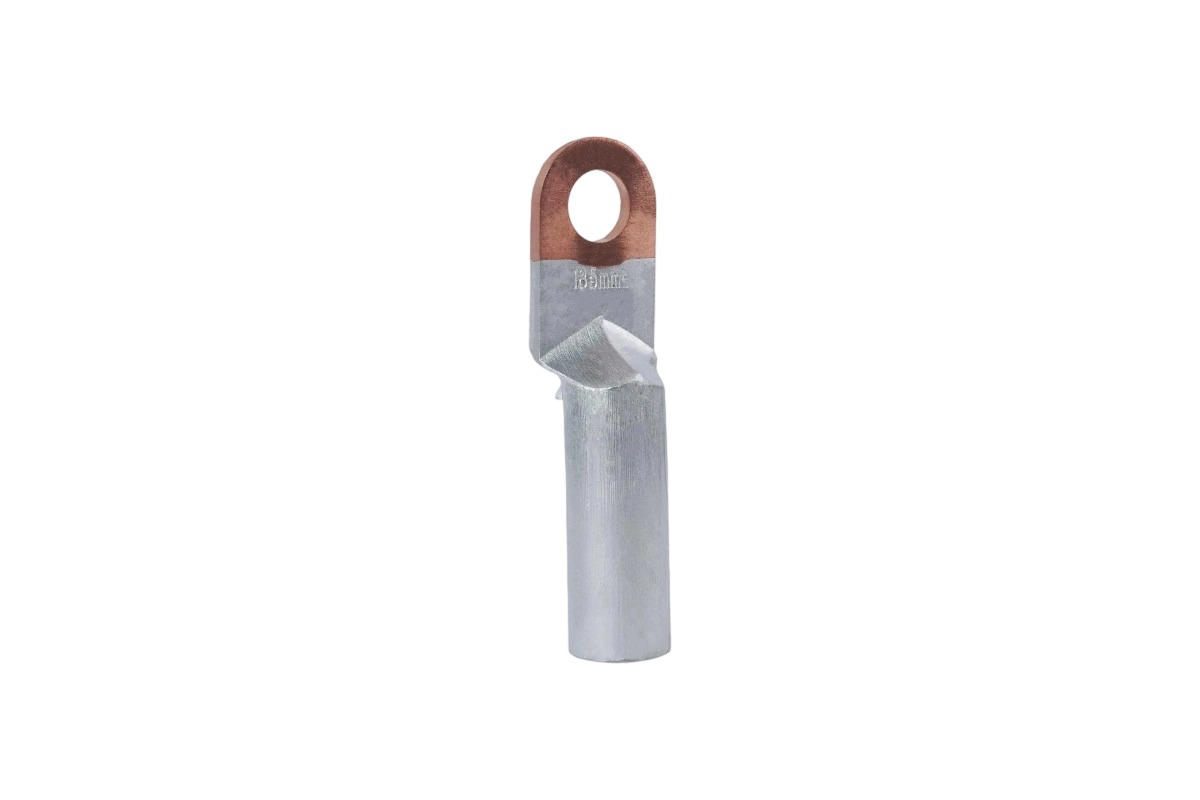
Engineers categorize these connectors into specific series. Understanding the DTL classification system helps you specify the correct component.
The DTL-1 Bimetal Crimp Lug represents the industry standard for most installations. It features a straightforward structure. A tubular aluminum barrel is friction-welded directly to a flat, solid copper palm. We use it extensively for standard medium-to-low voltage distribution. It safely connects aluminum power feeders to copper breakers, distribution blocks, or transformers. The flat palm provides maximum surface area contact against the equipment terminal.
You must evaluate different profiles based on your installation constraints.
DTL-2 Series: These variants feature a different transition design. They often utilize a longer copper section or a modified palm shape. Some DTL-2 models use a round copper pin instead of a flat pad.
Pin-Type Terminals: These serve very specific needs. They work best in extremely tight molded case circuit breakers (MCCB). The solid copper pin fits into tunnel terminals where a flat pad simply cannot go.
Your shortlisting logic should follow space constraints first. If you bolt onto a flat busbar, use DTL-1. If you insert the conductor into a cylindrical equipment clamp, choose a pin-type variant. Always verify the current rating matches your specific load requirements.
A lug that performs perfectly indoors might fail rapidly outdoors. You must align your specification with the physical environment.
High voltage demands strict design rules. Corona discharge poses a major threat at elevated voltages. Sharp edges ionize the surrounding air, creating corona. This degrades insulation and wastes energy. HV applications require lugs featuring smooth, heavily chamfered edges. Manufacturers must remove all burrs. You also need heavier barrel walls. Thick walls manage electrical stress effectively and prevent localized overheating.
Coastal areas and chemical plants destroy weak joints quickly. High airborne salinity accelerates corrosion. You must protect the entire connection. The bimetallic weld zone itself is solid, but the point where the cable enters the barrel remains vulnerable. You must completely seal this entry point. Installers should use heavy-wall heat shrink tubing. Cold shrink tubing also works excellently. Ensure the tubing includes an internal mastic adhesive to block moisture ingress.
Many installations move continuously. Heavy machinery vibrates constantly during operation. Renewable energy setups, like wind turbine nacelles, endure harsh wind loads and physical swaying. These environments dictate higher mechanical tensile strength. Ensure your chosen connector survives these intense physical demands. The friction weld must absorb these vibrations without cracking. Proper support cleats along the cable routing also reduce direct mechanical strain on the terminal pad.
The best hardware fails if installed incorrectly. Installation discipline matters just as much as material purity.
Aluminum forms a tough, invisible oxide layer within seconds of exposure to air. This sapphire-hard layer acts as an electrical insulator. Surface preparation is mandatory. You must wire-brush the bare aluminum conductor thoroughly. Immediately apply an oxide-inhibiting joint compound. We commonly call this contact paste. The paste contains suspended zinc particles. These particles break through any remaining oxides during crimping. The compound also seals the strands against incoming oxygen.
You cannot use generic pliers or mismatched dies. Explain this to your installation teams clearly. You must use the manufacturer-specified hydraulic crimping tool. Hexagonal dies are strictly required for these tubular barrels. Hex dies apply uniform, 360-degree pressure. They achieve a solid cold weld between the cable strands and the barrel interior. Proper die selection ensures you do not compromise the delicate friction-welded joint above the compression zone.
Installation teams often make preventable errors. Watch out for these common mistakes:
Over-crimping: Using an undersized die applies excessive pressure. It extrudes the aluminum outward. It stretches and weakens the metal structure, causing micro-fractures.
Under-crimping: Using an oversized die leaves air gaps inside the barrel. These gaps increase resistance and cause immediate thermal issues.
Crimping too close to the weld: Never apply the crimp die near the bimetallic weld seam. The immense hydraulic pressure will deform the transition zone. Doing so fractures the molecular bond instantly, ruining the component.
Sourcing reliable components requires a systematic approach. Use this checklist to audit potential manufacturing partners.
Verify compliance carefully before purchasing. Manufacturers must test their products according to IEC 61238-1. This standard governs compression and mechanical connectors for power cables. It ensures the component handles both mechanical stress and electrical loads safely. North American projects might require specific UL listings instead. Always demand written proof of these certifications.
Do not accept marketing claims at face value. Require actual batch testing reports from the supplier. Focus closely on two specific tests. First, review the electrical heating cycle tests. The connector must survive hundreds of extreme temperature swings without increased resistance. Second, check the short-circuit current testing. This proves the lug will not melt or blast apart during a sudden, massive fault event.
A great product means nothing if you cannot get it on site. Assess the supplier's operational capacity.
Evaluate their lead times for critical project phases. Delays cost money.
Check their standard inventory availability. They should easily stock cross-sections ranging from 16mm² up to 630mm² and beyond.
Confirm their custom machining capabilities. Some equipment requires non-standard bolt sizes. Your supplier must be able to provide custom palm hole sizes quickly.
Choosing the correct bimetallic connectors serves as a critical risk-mitigation strategy. It ensures the absolute long-term reliability of your facility's power infrastructure. Upfront investment in correctly specified, high-purity DTL series components is essential for overall safety. Purchasing quality hardware completely offsets the massive costs associated with catastrophic joint failure and system downtime. We advise engineers to audit their current Al-Cu termination specifications immediately. Request rigorous sample testing reports from potential suppliers before finalizing your procurement contracts. Ensuring molecular-level fusion at the transition point guarantees your power flows smoothly for decades.
A: No. Paste prevents initial oxidation but cannot stop the galvanic corrosion or thermal expansion differences that will eventually destroy the joint. A true bimetallic lug is required.
A: Look for smooth, uniform weld seams without pitting. Ask the manufacturer for destructive testing data (tensile strength) and heat cycle test compliance.
A: While standard hydraulic crimpers are used, it is critical to use the exact die size recommended for the lug's outer diameter to ensure proper compression of the aluminum barrel.
A: Differences primarily lie in the manufacturing design, palm thickness, and the specific ratio/shape of the copper-to-aluminum transition. DTL-1 is the industry standard for flat equipment terminations.
