
Views: 0 Author: Site Editor Publish Time: 2026-07-22 Origin: Site


Connecting aluminum cables directly to copper busbars introduces severe risks to Low Voltage (LV) distribution. Without proper transition components, these connections often suffer from premature joint failure. Thermal runaway quickly follows, putting entire networks at risk. The electrical industry rapidly transitions toward aluminum cabling for its distinct cost advantages. This shift makes highly reliable aluminum-tocopper transition points an absolute necessity. Pre-insulated bimetallic cable lugs serve as the ultimate standard for modern installations. They actively mitigate galvanic corrosion and secure long-term electrical continuity. They also drastically reduce installation time compared to traditional methods. Engineers rely on these specialized lugs to ensure strict compliance in dense LV networks. You will discover exactly why these components dictate system reliability. We will explore the mechanics behind their anti-corrosion properties. We will also breakdown crucial specification differences to guide your next infrastructure project.
Galvanic Protection: Friction-welded copper and aluminum permanently eliminate the risk of electrochemical corrosion at connection points.
Installation Efficiency: Pre-insulated designs remove the need for secondary heat-shrink processes, reducing labor time and standardizing weatherproofing.
Model Specificity: Selecting the exact standard (e.g., DTL-4 vs. DTL-8) ensures alignment with regional compliance and specific mechanical load requirements.
Cost vs. Lifespan: While initial procurement costs are marginally higher than standard lugs, the prevention of LV network outages yields a heavily positive ROI.
Aluminum and copper possess widely different electrochemical potentials. Placing them in direct physical contact under an electrical load initiates a dangerous chain reaction. Moisture acts as an electrolyte in this scenario. It turns the joint into an active galvanic cell. The aluminum material acts as an anode and corrodes rapidly. This degradation creates an insulating oxide layer between the metals.
This oxide layer drastically increases the contact resistance at the joint. Higher resistance forces the connection to generate excessive heat under normal loads. You then face severe fire risks and eventual system collapse. Engineers must neutralize this threat entirely. Traditional jointing pastes only offer a temporary fix.
Manufacturers utilize an advanced friction welding process to solve this issue permanently. High-quality bimetallic components feature a pure aluminum barrel joined to a pure copper palm. The manufacturing machinery forces these two metals together at extremely high rotational speeds. The intense friction generates localized heat. The metals reach a plastic state rapidly. They then forge together under extreme pressure.
This process creates a permanent, solid-state weld. This outcome proves vital for modern LV networks. The solid-state weld eliminates any microscopic air gaps between the elements. It blocks moisture ingress entirely at the elemental transition point. By fusing the metals seamlessly, you isolate the aluminum and copper from environmental catalysts. The risk of electrochemical degradation drops to absolute zero. This engineering achievement secures the lifespan of your entire distribution panel.
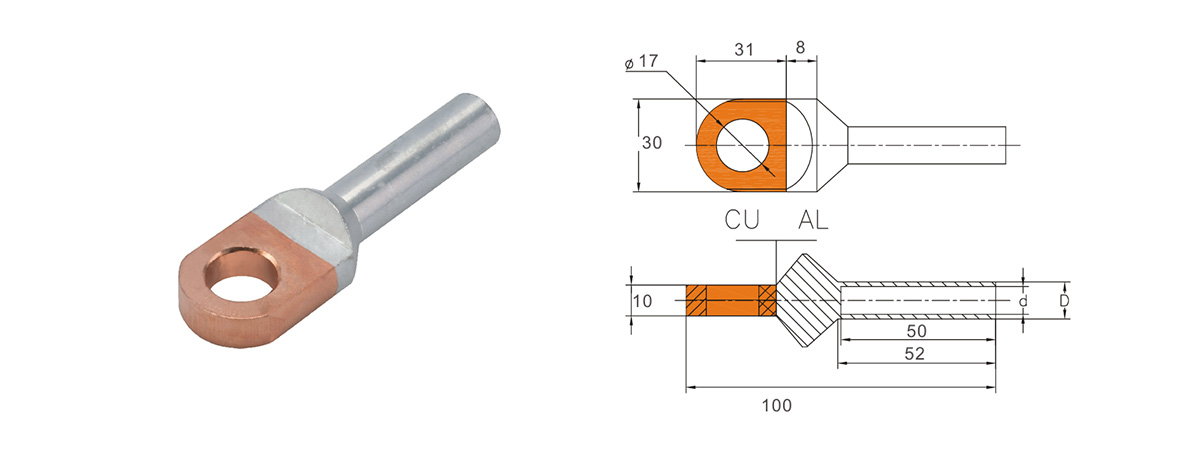
Environmental resilience stands as a top priority for electrical contractors. Pre-insulated lugs feature a highly robust insulation sleeve. Manufacturers usually craft this sleeve from durable EPDM or a cross-linked polymer. This protective layer shields the vital friction weld from harsh weather. It performs exceptionally well in outdoor cable installations. Harsh industrial environments also pose no threat. The polymer resists chemical exposure, high humidity, and extreme temperature fluctuations.
Dielectric strength offers another critical advantage for system safety. Modern LV enclosures constantly shrink in physical size to save space. Tight spaces increase the risk of accidental phase-to-phase short circuits. Integrated insulation provides immediate dielectric integrity. You do not have to worry about exposed conductive barrels touching neighboring phases. This built-in safety measure actively protects personnel during routine maintenance.
Labor efficiency drastically improves when you choose pre-insulated designs. Consider the traditional installation method. Technicians install bare lugs onto the cables. They then manually wrap them using electrical tape. Sometimes they apply multi-stage heat shrink tubing. These secondary processes waste valuable labor hours on site. They also introduce human error into the weatherproofing process.
Factory-grade insulation guarantees perfect consistency. You simply slide the component on, crimp it, and the termination is secure. It saves significant time per connection. It ensures uniform environmental protection across your entire project site. You eliminate the guesswork associated with manual taping.
Different LV infrastructure projects require very specific dimensional standards. You must align your component choices with strict compliance requirements. We categorize these decisions based on mechanical loads, regional codes, and application environments. Understanding the exact specifications prevents costly installation errors.
The DTL-4 Insulated Bimetal Lug represents a highly versatile industry standard. It typically features a moderately sized copper palm. The aluminum barrel length accommodates standard commercial crimping dies perfectly. The integrated insulation class reliably covers typical commercial LV requirements. Manufacturers design it for streamlined mass installations.
You will find it ideal for standard commercial LV panels. Technicians frequently deploy them for specific utility meter connections. They handle moderate mechanical stress exceptionally well indoors. They suit commercial building environments seamlessly. If your project demands fast, reliable terminations in standard enclosures, this model delivers excellent results.
You might face much more demanding industrial applications. The DTL-8 European Bimetallic Crimp Terminal answers this specific call. It boasts noticeable structural differences compared to standard variants. It often features much thicker aluminum barrels. The copper palms are notably longer and more robust. The specific hole alignments perfectly match European standard busbars.
We recommend them for highly strict applications. Use them when you require strict adherence to CE or IEC standards. They perform flawlessly in high-vibration industrial environments. The extra material thickness handles heavy mechanical loads effortlessly. Wind turbines and heavy manufacturing plants benefit greatly from this robust design.
Standard Specifications Comparison
Specification Criterion | DTL-4 Series | DTL-8 Series |
|---|---|---|
Primary Application | Commercial LV panels, utility meters | Industrial enclosures, heavy machinery |
Barrel Thickness | Standard | Reinforced / Extra Thick |
Palm Design | Compact, round or square profile | Extended, aligned for EU busbars |
Vibration Tolerance | Moderate | High |
Compliance Focus | General commercial standards | Strict CE / IEC standards |
Buyers must evaluate supplier claims strictly. Low-quality components look identical to premium ones on a spreadsheet. Use this evidence-based framework to vet your components before purchasing.
Weld Integrity: Never assume the friction weld is perfect. Request actual tensile strength test reports from the manufacturer. Ask for micro-resistance data across the joint. A flawless weld shows no resistance spike at the transition point.
Material Purity: Substandard metals cause rapid system failures. Emphasize checking the exact conductivity grades. Ensure the aluminum uses grade L3 or equivalent high purity. Verify the copper uses grade T2. Impurities lead to unpredictable heating under heavy loads.
Sizing Accuracy: Exact internal barrel diameters matter immensely. A loose barrel guarantees your crimp will fail. Loose crimps cause micro-arcing post-installation. Always ask for precise dimensional tolerance sheets.
Insulation Ratings: Verify the environmental limits of the polymer sleeve. Ask for UV resistance certification if you plan for outdoor use. Request thermal aging reports. You need hard proof the insulation will not crack after five years in the field.
Always request a physical sample batch. Conduct your own destructive testing if possible. Cut the barrel open to inspect the internal solid-state weld. Look for complete fusion without any porosity. True expertise in procurement requires verifying these unseen details.
Even the most premium lugs fail if you install them incorrectly. We must address these adoption risks head-on. Many contractors blame the component when poor installation techniques cause the actual failure. Proper training mitigates these common errors.
Tooling compatibility dictates your success. You absolutely must use the correct hexagonal crimping dies. Copper dies do not work properly on aluminum barrels. Warn your team against over-crimping. Excessive force fractures the aluminum barrel. This ruins the mechanical grip and compromises the joint. Warn them against under-crimping as well. Loose connections cause high-resistance hot spots. These hot spots eventually melt the insulation and cause fires.
Follow these mandatory preparation steps for every single connection:
Strip the cable insulation carefully. Ensure you do not nick or cut the internal aluminum strands.
Remove the invisible oxide layer from the aluminum conductor. Use a dedicated wire brush immediately before termination.
Apply an antioxidant jointing compound thoroughly. Do this unless you purchased lugs pre-filled with factory paste.
Insert the conductor fully into the barrel. Verify the depth before applying the crimping tool.
Quality assurance prevents future outages. We strongly recommend strict visual inspection protocols. Check for uniform hex shapes after crimping. Look for any extruded metal burrs. Next, perform a thermographic infrared scan. Do this after your initial load testing. A glowing hot spot on the camera indicates a failed crimp. Catch it early before it destroys the LV panel.
Insulated bimetallic cable lugs act as critical failure-prevention components for modern LV infrastructure. They actively stop galvanic corrosion and prevent disastrous thermal runaway. We validate that specifying exact models remains non-negotiable for serious projects. You must choose between the DTL-4 or DTL-8 based on regional codes and application standards. This focused approach ensures long-term safety and strict code compliance.
Do not compromise on your transition points. Take action now to secure your electrical network. Request comprehensive technical data sheets from your verified supplier. Ask for physical sample kits to conduct your own crimp testing. Schedule a technical consultation regarding your specific LV panel requirements today.
A: They are generally not rated for direct burial without additional protection. While the EPDM insulation provides excellent splash and UV resistance, it lacks the IP rating required for constant submersion. You must use secondary mechanical protection, such as heavy-wall adhesive-lined heat shrink or a waterproof resin joint kit, for underground burial.
A: No, you cannot. Aluminum barrels possess different outer diameters and require specific expansion tolerances compared to copper. You must use hexagonal dies specifically sized for aluminum compression. Using copper dies leads to severe over-crimping or under-crimping, which compromises the connection.
A: Assuming proper installation and balanced electrical loads, you can expect a service life of 20 to 30 years. The solid-state friction weld prevents internal corrosion. However, external polymer insulation may show signs of thermal aging or UV degradation after two decades in extreme environments.
A: Many premium bimetallic lugs come factory pre-filled with antioxidant paste inside the aluminum barrel. If they are pre-filled, you do not need to add more. If you purchase un-filled models, you must manually apply the jointing compound after wire brushing to prevent rapid aluminum oxidation.
